
Document and Photo Restoration
Save The Day Restoration provides specialty document and photo restoration throughout Los Angeles and Orange County using vacuum freeze-drying technology to halt mold growth, prevent ink bleeding, and stabilize water-exposed paper, photographs, and records that visually appear destroyed at the time of pack-out.
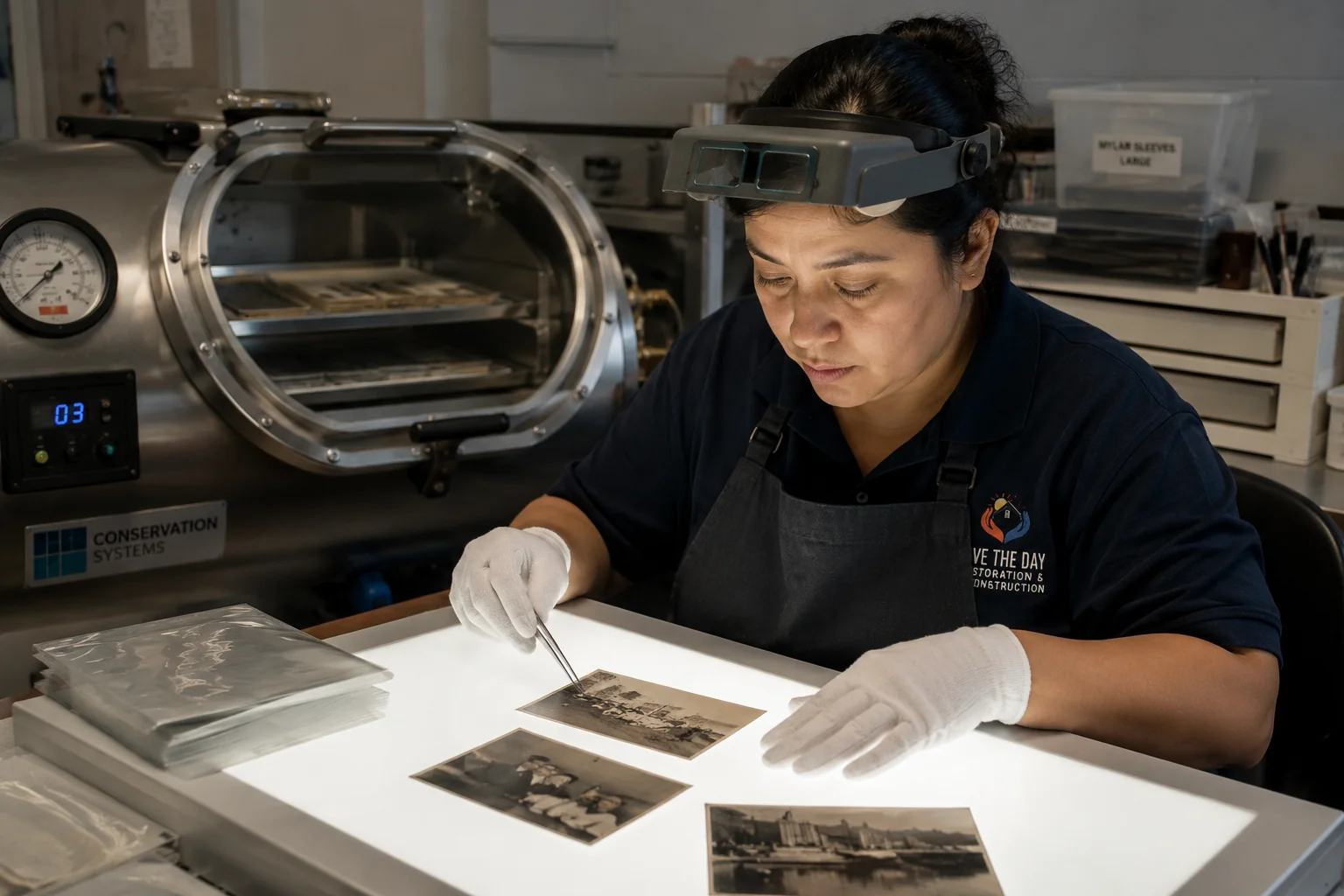
Document and Photo Restoration Services in Los Angeles and Orange County
Water-damaged documents and photographs look hopeless at first glance — soaked, stuck together, blurred ink, visible mold starting. Most homeowners assume they're total losses. They're usually not. Save The Day Restoration provides vacuum freeze-drying document and photo restoration across Los Angeles and Orange County, using technology developed for archival preservation to halt mold growth, prevent ink bleeding, and stabilize water-exposed paper. Family records, business documents, photographs that look destroyed are routinely returned to readable, archival-stable condition. The 48-hour window matters — call (562) 246-9908 immediately if you have water-damaged paper.
The 48-Hour Window for Water-Damaged Paper
Water-damaged paper deteriorates fast. Within 24 to 48 hours of water exposure, mold growth begins on most paper materials. Within the same window, ink starts bleeding and becoming illegible. Pages stick together as paper fibers swell. Photographs lose emulsion as the gelatin layer softens. Without intervention, the damage compounds: mold spreads through stacks of documents, ink bleed crosses pages, stuck-together photos can no longer be separated without destroying both, and what was a moisture problem becomes a total loss.
The intervention that stops this clock is freezing. Wet documents and photographs get frozen as quickly as possible after the water event — ideally within the 48-hour window before mold establishes. Freezing halts mold growth, stabilizes ink, prevents further pages from sticking, and locks the materials in their current state until proper restoration can begin. From there, vacuum freeze-drying removes the moisture without the warping, ink bleed, and emulsion damage that conventional drying causes.
The implication is operational: when water-damaged documents are part of a pack-out, we treat them as time-critical regardless of the rest of the scope. Photographs from photo albums in a flooded basement, business records in a water-damaged office, family genealogy paperwork from a burst pipe under a kitchen — anything paper that's wet goes into freezer storage on Day 1, not when the larger pack-out scope catches up to it.
How Vacuum Freeze-Drying Works
Vacuum freeze-drying (technically called lyophilization) is the same technology used to preserve archival documents at libraries and museums. Frozen wet documents go into a vacuum chamber where the pressure is reduced to near-vacuum levels. At low pressure, the frozen water in the documents undergoes sublimation — the ice converts directly from solid to vapor without passing through a liquid phase. The water vapor is captured by a cold trap in the chamber while the documents themselves stay frozen and dry out.
The result is that documents and photographs are dried without ever passing through the wet-paper-to-dry-paper transition where most damage occurs. Pages don't warp because there's no liquid water surface tension. Ink doesn't bleed because there's no liquid to carry it. Stuck pages can be separated after drying because the moisture that bound them is gone. Photo emulsion stays intact because the gelatin doesn't soften through liquid contact during drying. The documents come out of the chamber looking — and reading — as they did before water damage, with some textural change to the paper that doesn't affect legibility or archival value.
The technology has limits. Documents already advanced into mold growth lose some of the recovery probability. Documents with pre-existing damage (fragile old paper, brittle records) require additional handling. Photographs printed on certain modern photographic papers have different recovery characteristics than older silver-gelatin prints. The decision about whether freeze-drying is the right approach for a specific document or photograph happens during the inventory and assessment phase.
What's Salvageable Versus What's Not
Most water-damaged paper is salvageable through freeze-drying when intervention happens within the window. Books with intact bindings, loose paper records, business documents in folders, family genealogy paper, certificates and licenses, even children's art on standard paper — all typically respond well. Photographs vary by type but most are salvageable: silver-gelatin prints, color photographs in standard albums, recent inkjet prints on photo paper. Stuck-together photos can usually be separated post-freeze-drying. Photographs that have lost emulsion entirely cannot be restored, and emulsion damage usually progresses past restorability if the materials sit wet beyond the 48-hour window.
What's typically not salvageable: documents already showing extensive mold growth at intake, paper with severe charring from direct flame exposure, items with chemical contamination beyond water exposure (e.g., sewage saturation, certain firefighting foam exposure), and photographs that have lost emulsion before freezing. These get documented for the contents claim with detailed condition reports supporting replacement value where applicable.
Stuck-Together Photos and Pages
The single most common question we get on document restoration is whether stuck-together photographs can be separated. The answer is usually yes — after freeze-drying. Wet photographs stuck together, when handled wet, will tear. The emulsion layer softens with moisture and adheres to the back of adjacent photos or pages. Pulling them apart while wet destroys both. Freeze-drying first, then careful separation post-dry, has a much higher success rate. Not 100%, but high enough that the protocol is to freeze first, attempt separation later, rather than try to handle wet photos.
Same for stuck pages in books. Wet pages adhere to each other through the swollen paper fibers. Forcing separation wet damages both pages. Freeze-drying allows the pages to be separated post-dry with care.
Official Documents and Legal Records
Documents like birth certificates, deeds, passports, business records, and insurance policies are common in pack-outs for property damage events. The freeze-drying process doesn't alter the document content — the ink is preserved, the paper structure is preserved, the seals and signatures are preserved. Restored documents remain legally valid because the document itself isn't altered, only dried.
For documents that need to be replaced through their issuing authority — driver's licenses, certain certificates — the freeze-dried originals serve as supporting documentation for replacement applications. The combination of restored original plus replacement application typically processes faster than starting from scratch with no original.
Coverage and Process
Document and photo restoration is covered under your homeowner's contents coverage like the rest of pack-out, billed in Xactimate line items per the standard restoration scope. Cost is typically priced per cubic foot of documents or per item for high-value individual photographs and rare documents. Storage during processing runs the same monthly rate as climate-controlled contents storage.
The process flow is: emergency stabilization (freeze within 48 hours of intake), inventory and condition assessment, vacuum freeze-drying chamber treatment, selective mold treatment for items that started growth before freeze, page separation for stuck materials, archival repackaging, and condition reports for items that couldn't be restored. The full process takes one to three weeks for typical pack-outs depending on volume.
Working With Appraisers for Rare Items
For pack-outs involving rare books, historical documents, signed first editions, original photographs of significant historical value, or other items where appraisal value matters, we coordinate with conservation specialists and appraisers. The freeze-drying process is appropriate for most of these items — it's the same technology used at major libraries — but specific handling requirements may apply (additional documentation, specialty packing, restricted access during processing). Items insured on fine arts or rare-book riders receive coordination with the rider's specific protocols.
For homeowners with genealogical archives, family historian collections, or business archives where the value isn't on a rider but is high in scope, we can document and stage the materials for review by a conservation specialist before processing. Call (562) 246-9908 to discuss specific document or photograph restoration needs.
Our Document and Photo Restoration Process Includes:
01
Emergency Stabilization (Freeze Within 48 Hours)
Wet documents and photographs go into freezer storage immediately on intake to halt mold growth, ink bleed, and adhesion before restoration begins.
02
Inventory & Condition Assessment
Frozen materials are inventoried, condition-assessed, and routed to the appropriate restoration workflow based on item type and contamination.
03
Vacuum Freeze-Drying Chamber Treatment
Vacuum chamber sublimation removes water from frozen documents and photographs without the warping, ink bleed, or emulsion damage that conventional drying causes.
04
Selective Mold Treatment
Items with mold growth that began before freeze receive selective mold treatment after freeze-drying to remove visible contamination and prevent regrowth.
05
Page and Photo Separation
Stuck-together photographs and pages are carefully separated post-drying using techniques developed for archival recovery.
06
Archival Repackaging
Restored materials go into archival-quality folders and boxes designed for long-term preservation in climate-controlled storage.
07
Restoration Coordination for Rare Items
Rare books, historical documents, and items insured on fine arts or rare-book riders are coordinated with conservation specialists or appraisers as needed.
08
Inventory Return with Condition Reports
Restored items return with condition reports documenting pre-freeze, post-freeze-drying, and final condition for the contents claim.
What we handle
Specialized services for your specific damage

Emergency Pack-Out
Same-day emergency pack-out across LA & Orange County. Coordinated with active fire, water, or mold restoration to remove contents from contaminated environments before secondary damage sets in. Call (562) 246-9908.

Content Pack-Out Services
Content pack-out services in LA & Orange County. Professional inventory, packing, cleaning & storage of belongings during restoration. Insurance-covered. Call (562) 246-9908.
We work with all major insurance carriers






CITIES WHERE THIS SERVICE IS AVAILABLE
Same certified technicians, same fast response — wherever you are in LA or Orange County. Select your city to see local details and schedule service.


WHERE WE OFFER THIS SERVICE
24/7 emergency response across Los Angeles and Orange County. Click your city for local service details and response times.
Common Questions
Common questions about this service
Vacuum freeze-drying (lyophilization) is the same technology used at libraries and museums for archival preservation. Frozen wet documents go into a vacuum chamber where reduced pressure causes the ice in the documents to sublimate directly into vapor without passing through a liquid phase. Documents dry without the warping, ink bleed, or emulsion damage that liquid-phase drying causes.
Usually yes — after freeze-drying. Wet photos and pages stuck together cannot be separated when wet without destroying both. Freeze-drying first, then careful separation post-dry, has high success rates for most materials. Not 100%, but high enough that the standard protocol is freeze first, attempt separation later, rather than try to handle wet photos.
Yes. The freeze-drying process doesn't alter document content — ink is preserved, paper structure is preserved, seals and signatures are preserved. Restored documents remain legally valid because the document itself isn't altered, only dried. For documents requiring replacement through their issuing authority, restored originals serve as supporting documentation for replacement applications.
One to three weeks for typical pack-outs depending on document volume. Emergency freeze stabilization is immediate (within 48 hours of intake). Vacuum freeze-drying takes several days to a week depending on volume. Selective mold treatment, separation work, and archival repackaging add another few days. We provide status updates throughout for homeowners with time-sensitive document needs.
We coordinate with conservation specialists and appraisers for items where archival or appraisal value matters. The freeze-drying technology is appropriate for most of these items — it's the same technology used at major libraries — but specific handling protocols may apply. Items insured on fine arts or rare-book riders receive coordination with the rider's specific requirements.
Need more answers?
Reach out anytime
Damage is happening right now
Call (562) 246-9908 now. Licensed #1049188. IICRC certified. We're dispatching immediately.
