In this guide
Additional living expense coverage can help with increased living costs when a covered loss makes the home uninhabitable. Eligibility, limits, duration, and documentation depend on the policy.
Keep it handy
A free printable for this guide
Save a copy for your fridge or binder. No email needed.
Recovery expense & receipt log
Keep temporary housing, meals, travel and other recovery receipts in one place.
Read the checklist online
Use a new sheet as needed. Keep itemized receipts and record what each purchase was for.
Recording an expense does not mean it is covered. Ask your insurer about eligibility, limits, documentation and advance approval.
Before you submit
- Ask how to distinguish additional living costs from your normal household spending.
- Give each receipt a reference number and keep a digital backup.
- Record submissions and the insurer's response separately from what you spent.
Space to fill in
- Claim reference / dates covered
- Usual cost baseline / insurer instructions
Expense record
Columns: Date; Vendor / purpose; Amount; Receipt ref.; Submitted / status. 5 blank rows.
Sheet total: ____________________ Submitted on: ____________________
Reference guidance
Quick Answer: Additional Living Expenses (ALE) coverage—also called Coverage D or Loss of Use—pays for temporary housing and increased living costs when your home is uninhabitable due to a covered insurance event. ALE typically covers 20-30% of your dwelling coverage amount for 12-24 months. Covered expenses include temporary rental housing, hotel costs, restaurant meals above your normal food budget, storage for belongings, laundry services, pet boarding, and additional commuting costs. ALE only covers the difference between your normal expenses and your increased expenses while displaced. Keep all receipts. Call Save The Day Restoration at (562) 246-9908—we help coordinate ALE needs during restoration across LA and Orange County.
What Does ALE Coverage Include?
ALE coverage is designed to maintain your normal standard of living while your home is being restored. It covers reasonable and necessary increases in living expenses—not a blank check for luxury living, but not a punishment either.
Temporary housing: Rental homes, apartments, extended-stay hotels, or short-term furnished rentals comparable to your normal living standard. If you lived in a 3-bedroom home in a specific school district, ALE covers a comparable rental in a similar area—not a studio apartment across town. In LA and Orange County, where rental costs are among the highest in the country, ALE coverage is particularly important.
Increased food costs: When you can't use your kitchen, ALE covers restaurant meals and takeout above your normal food budget. The key word is "increased"—if you normally spend $800/month on groceries, and you're now spending $1,500/month on restaurants because you have no kitchen, ALE covers the $700 difference.
Storage: If your belongings need to be removed from the home during restoration, ALE covers storage unit rental.
Laundry: Without access to your washer and dryer, laundromat or laundry service costs are covered.
Pet boarding: If your temporary housing doesn't allow pets, boarding or pet daycare costs are covered.
Additional transportation: If your temporary housing is farther from work or school than your damaged home, the additional commuting cost is covered (mileage difference, additional gas, tolls).
Moving costs: The cost of moving belongings to and from temporary housing and storage is covered.
How Much ALE Coverage Do You Have?
ALE coverage is typically defined as a percentage of your dwelling coverage (Coverage A). Common ALE limits are 20-30% of dwelling coverage. For example, with $500,000 dwelling coverage at 20% ALE, your total ALE budget is $100,000. With $800,000 coverage at 30%, your ALE budget is $240,000.
ALE also has a time limit, typically 12-24 months from the date of loss. Your policy specifies both the dollar limit and the time limit—whichever is reached first. In LA and Orange County, where temporary housing can cost $3,000-$6,000+/month, even generous ALE limits can be consumed faster than expected. Monitor your ALE spending and communicate with your adjuster if you're approaching limits.
How Do You Use ALE Effectively?
How Do You Find Temporary Housing?
Start looking immediately after the damage event—temporary housing in LA and Orange County fills quickly, especially after regional disasters. Options include furnished short-term rental homes (VRBO, Furnished Finder, corporate housing companies), extended-stay hotels (Residence Inn, Homewood Suites, Extended Stay America), month-to-month apartment rentals, and staying with family or friends (ALE may reimburse them for reasonable hosting costs).
Prioritize housing in your same general area to minimize disruption to work, school, and daily routines. Your restoration company can recommend temporary housing resources and may have relationships with local providers.
What Documentation Do You Need?
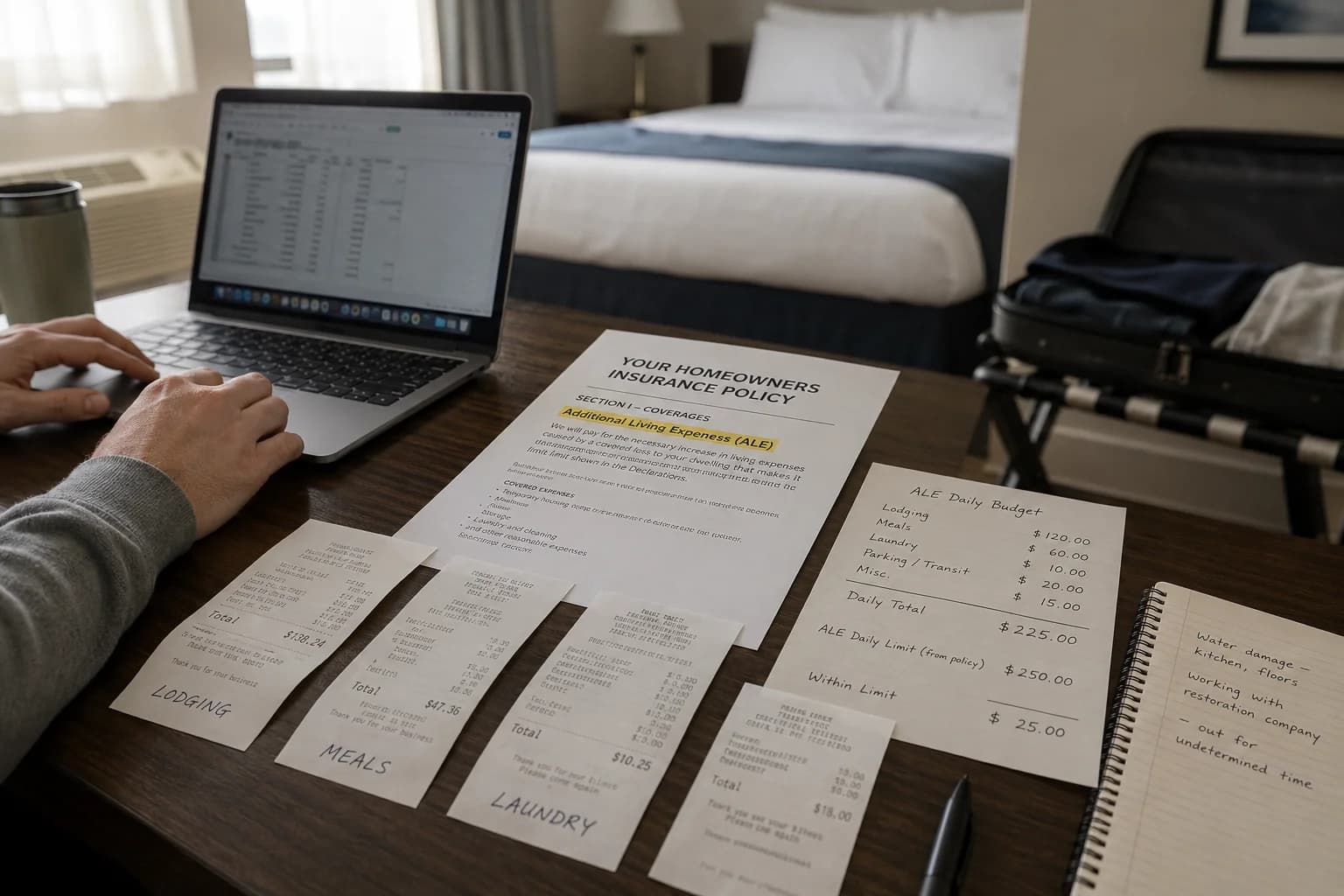
Keep every receipt for every expense. Maintain a log of all ALE-related spending with dates, amounts, and descriptions. Separate normal expenses from increased expenses (you're only reimbursed for the increase). Submit expense reports to your insurance company regularly (monthly is typical). Keep your adjuster informed about your temporary housing situation and any changes in circumstances.
What ALE Mistakes Should You Avoid?
Don't assume unlimited spending—ALE covers reasonable expenses comparable to your normal standard of living, not upgrades. Don't neglect documentation—undocumented expenses may not be reimbursed. Don't wait to find housing—the longer you delay, the fewer options are available and the more expensive they become. Don't forget to factor in the full reconstruction timeline—ALE needs to last from damage event through move-in, including mitigation, permitting, and reconstruction. Don't ignore communication with your adjuster—proactive communication about ALE usage prevents surprises and disputes.
What If Your ALE Coverage Runs Out Before Reconstruction Is Complete?
If ALE limits are approaching before reconstruction is complete, notify your insurance adjuster immediately and document the reason for the extended timeline. If delays are caused by insurance processing, supplemental claims, or permitting, the insurer may extend ALE. If delays are caused by your own decisions (material selection delays, scope changes), extensions are less likely. Consult with your restoration contractor and insurance agent about options. A public adjuster can advocate for ALE extensions when justified.
FAQ: ALE Coverage
Q: Does ALE cover my mortgage while I'm paying rent?
A: No. ALE does not cover your mortgage, property taxes, or homeowner's insurance—these are obligations you would have regardless of the damage. ALE covers the additional cost of living elsewhere—primarily the rent and increased living expenses above your normal budget.
Q: Can I stay in a hotel indefinitely on ALE?
A: Hotels are covered but are typically the most expensive temporary housing option. For extended displacement (more than a few weeks), transitioning to a rental home or apartment is both more comfortable and more cost-effective for preserving your ALE budget.
Q: Does ALE apply if only part of my home is uninhabitable?
A: ALE applies when your home is not fit for its normal use. If restoration work makes the kitchen, bathrooms, or bedrooms unusable—or if health hazards (mold, contamination) make occupancy unsafe—ALE applies even if some rooms are technically accessible.
Q: Can I receive ALE as a lump sum?
A: Some insurers offer lump-sum ALE payments or periodic advances rather than reimbursement. This can simplify the process, especially for long-term displacement. Ask your adjuster about payment options.
Q: What if I stay with family instead of renting?
A: If you stay with family or friends, you can often still claim reasonable ALE expenses—additional grocery costs for the host household, sleeping accommodations (air mattresses, linens), and other reasonable hosting costs. Document these expenses and discuss with your adjuster.
Q: Does Save The Day help with ALE coordination?
A: Yes. We help coordinate temporary housing needs, provide accurate reconstruction timelines for ALE planning, communicate with adjusters about project milestones, and work to minimize total displacement time through efficient restoration and reconstruction management. Call (562) 246-9908.
Know Your Coverage Before You Need It
Review your ALE coverage now—before a damage event—so you know exactly what resources are available if your home becomes uninhabitable.
Call Save The Day Restoration at (562) 246-9908 for restoration and reconstruction that minimizes your displacement time throughout Los Angeles and Orange County. IICRC-certified technicians, licensed general contractor #1049188, direct insurance billing with all major carriers.
How we prepare and update our guides
Related serviceAdditional ServicesBoard-up, cleaning & specialty workAbout Save The Day Restoration
Save The Day Restoration is a locally owned, IICRC-certified restoration and reconstruction company serving all of Los Angeles and Orange County. The team coordinates water, fire, and mold restoration and reconstruction, including specialist work when needed. Licensed (CSLB #1049188), bonded, and insured, with 24/7 emergency response.
Call (562) 246-9908