Fire Damage Restoration
Fire damage restoration is a professional service that secures fire-damaged properties, removes smoke and soot contamination from all surfaces and structural materials, extracts water used during firefighting, eliminates smoke odor through thermal fogging and hydroxyl treatment, remediates secondary mold growth, and reconstructs damaged areas to restore residential and commercial properties to pre-loss condition after structure fires, wildfires, and smoke exposure events.
Professional Fire Damage Restoration Services in Southern California
Quick Answer: Fire damage restoration includes emergency board-up and tarping, water extraction from firefighting efforts, smoke and soot removal from all surfaces, structural assessment, odor elimination, content cleaning, mold prevention, and complete reconstruction. Do not enter a fire-damaged property until authorities clear it—hidden structural hazards, electrical dangers, and toxic air quality create serious risks. Save The Day Restoration provides 24/7 emergency fire damage restoration throughout Los Angeles and Orange County. IICRC-certified technicians, licensed general contractor #1049188, direct insurance billing. Call (562) 246-9908.
Why Is Professional Fire Damage Restoration Essential?
Fire damage extends far beyond what's visibly burned. The fire itself destroys materials in its direct path, but smoke, soot, and the water used to extinguish the fire cause damage throughout the entire structure—including rooms the fire never reached. Smoke travels through HVAC ductwork, wall cavities, electrical penetrations, and any opening in the building envelope, depositing corrosive soot residue on every surface it contacts.
Soot is acidite and chemically active. Within hours of a fire, soot begins etching and permanently staining metal surfaces, glass, countertops, porcelain, and appliances. Within days, it discolors painted walls, plastics, and fabrics beyond restoration. Within weeks, it corrodes electronics, wiring, and plumbing fixtures. The chemical composition of soot varies based on what burned—synthetic materials (carpet, plastics, foam) produce protein and chemical soot that is far more corrosive and difficult to remove than soot from natural materials like wood.
Simultaneously, the thousands of gallons of water used during firefighting saturate the structure from above, creating extensive secondary water damage. This water mixes with ash and soot, creating a caustic slurry that penetrates drywall, insulation, framing, and flooring. Without professional extraction and drying, mold growth begins within 48 hours—compounding fire damage with biological contamination.
Professional fire damage restoration addresses all three damage categories simultaneously: fire/heat damage, smoke/soot contamination, and water damage from suppression efforts. This requires a company with expertise across all restoration disciplines and the construction license to rebuild what was destroyed.
What Types of Fire Damage Affect LA & Orange County Homes?
How Does Structural Fire Damage Occur?
Structure fires from kitchen accidents, electrical failures, heating equipment, and appliance malfunctions cause direct thermal damage to building materials. Wood framing chars and loses structural integrity at temperatures above 300°F. Steel connections weaken at sustained temperatures above 1,000°F. Concrete and masonry can crack and spall from thermal shock. Glass shatters, roofing materials melt or ignite, and plumbing and electrical systems fail.
The extent of structural damage depends on fire intensity, duration, and the materials involved. A kitchen fire contained to one room may require localized demolition and reconstruction. A fire that spreads through the attic or wall cavities can compromise structural framing across the entire home, requiring engineering assessment and extensive structural repair.
How Does Smoke and Soot Damage Spread?
Smoke and soot contamination typically affects a much larger area than the fire itself. Smoke is driven by heat and pressure differentials, traveling through every opening in the building: HVAC ductwork distributes smoke throughout the entire home, wall cavities and electrical/plumbing penetrations carry smoke between rooms and floors, attic spaces fill with smoke that settles onto insulation and framing, and gaps around doors, windows, and fixtures allow smoke to reach every room. Different fire sources produce different soot types. Protein soot from kitchen fires is nearly invisible but extremely pungent and difficult to remove. Synthetic soot from burning plastics, carpet, and furnishings is black, sticky, and highly corrosive. Wood smoke soot is dry and powdery but penetrates porous materials deeply. Each soot type requires specific cleaning methods, chemicals, and techniques.
How Does Wildfire Smoke Affect Homes?
Southern California's wildfire seasons expose hundreds of thousands of homes to exterior smoke infiltration even when the fire doesn't reach the structure. Wildfire smoke enters through ventilation systems, windows, doors, and building envelope gaps, depositing fine particulate matter and soot on interior surfaces. Extended wildfire smoke exposure can require professional cleaning of all surfaces, HVAC system cleaning, air duct cleaning, and air quality testing—even in homes miles from the fire itself. Homes in designated Very High Fire Hazard Severity Zones throughout LA and Orange County hillside communities face elevated wildfire risk requiring both prevention planning and rapid restoration response when fires occur.
What Does the Fire Damage Restoration Process Include?
How Is the Property Secured After a Fire?
Emergency board-up and tarping is the critical first step. Fire-damaged properties have compromised openings—broken windows from heat and firefighting, damaged doors, roof penetrations, and structural breaches—that expose the interior to weather, theft, vandalism, and animal intrusion. Professional board-up crews secure all openings with plywood and install roof tarps over damaged sections within hours of fire department clearance. This emergency securing is covered by insurance as part of your duty to mitigate further damage.
How Is Fire and Water Damage Assessed?
A comprehensive assessment documents the full extent of fire, smoke, soot, and water damage throughout the structure. This includes structural integrity evaluation (determining which framing members, roof structures, and load-bearing elements need replacement versus repair), smoke and soot penetration mapping (identifying every affected surface and material), water damage assessment from firefighting suppression (moisture mapping with thermal imaging and meters), content evaluation (determining which belongings can be cleaned and restored versus replaced), and HVAC system contamination assessment. This assessment forms the foundation of your insurance claim and the restoration scope of work.
How Is Water from Firefighting Removed?
Firefighting efforts often introduce thousands of gallons of water into a structure. This water mixes with ash, soot, and debris, creating contaminated water classified as Category 2 or 3 depending on what it contacts. Professional extraction uses truck-mounted systems to remove standing water, followed by structural drying with commercial dehumidifiers and air movers. Water damage from firefighting is covered under your fire damage claim—it's a direct consequence of the covered peril.
How Are Smoke and Soot Professionally Removed?
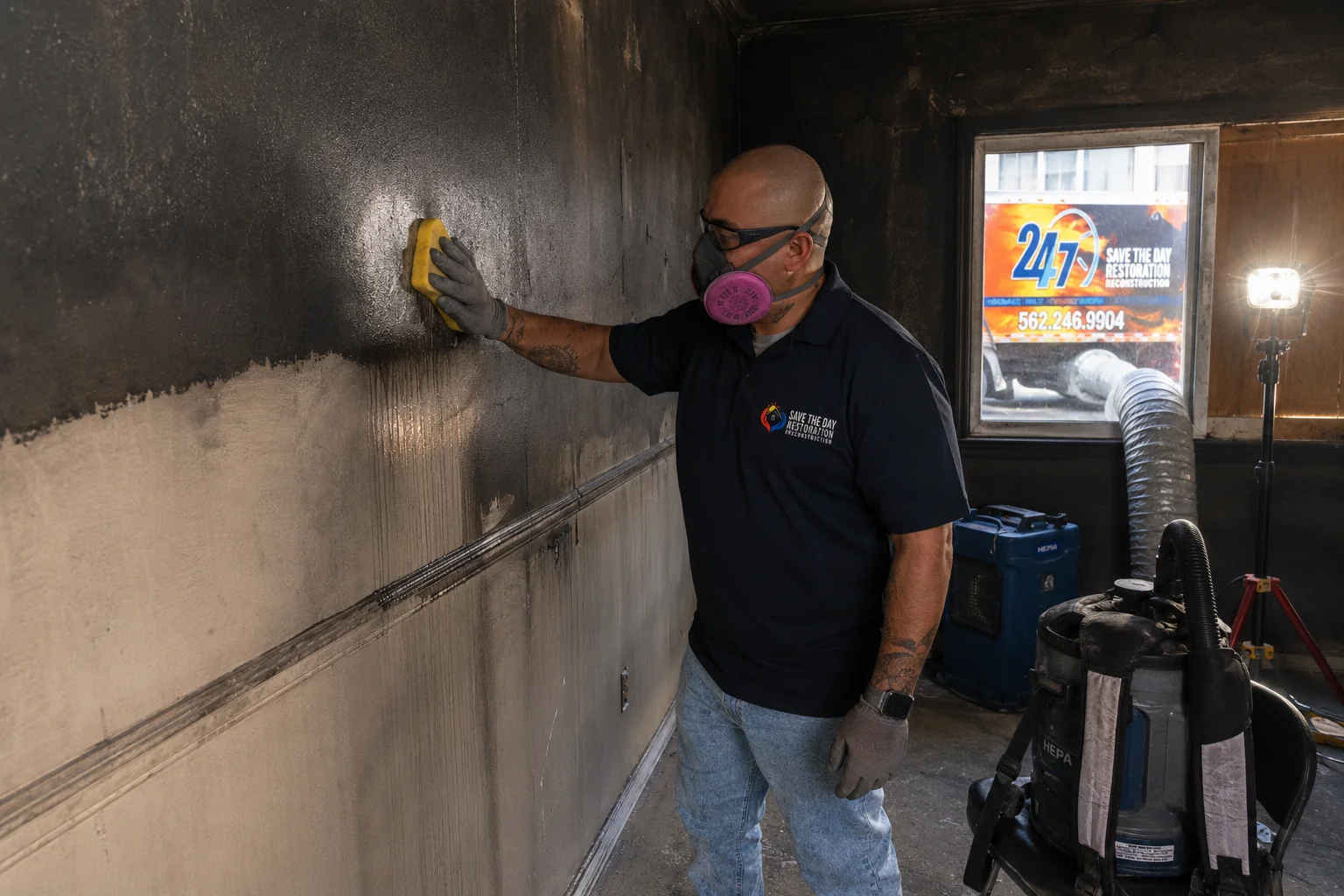
Soot removal requires material-specific cleaning methods. Dry soot (from wood fires) is removed with dry chemical sponges and HEPA vacuuming before any wet cleaning—wet cleaning dry soot smears it permanently into surfaces. Wet/oily soot (from synthetic materials) requires solvent-based cleaners and degreasing agents. Protein soot (from kitchen fires) requires enzyme-based cleaners that break down organic compounds.
Professional soot removal addresses every affected surface: walls, ceilings, exposed framing, concrete, hard flooring, countertops, cabinetry, fixtures, glass, metal, and all exposed building systems. Porous materials that have absorbed soot and cannot be adequately cleaned—drywall, insulation, carpet, fabric, and some wood products—are removed for replacement during reconstruction.
How Is Smoke Odor Eliminated?
Smoke odor is one of the most persistent and difficult restoration challenges. Smoke particles penetrate every porous material in the home: drywall, wood, insulation, fabric, carpet, clothing, and even concrete. Surface cleaning removes visible soot but not the microscopic smoke particles embedded within materials.
Professional odor elimination uses multiple complementary technologies. Thermal fogging disperses solvent-based deodorizers as a heated fog that penetrates the same crevices and materials smoke reached. Hydroxyl generators produce hydroxyl radicals that chemically break down odor-causing molecules at the molecular level—safe for occupied spaces and effective on embedded odors. Ozone treatment (in unoccupied spaces only) oxidizes organic odor compounds. HEPA air scrubbers with activated carbon filters continuously remove airborne smoke particles and odor compounds. Severe smoke odor may require sealing affected surfaces with shellac-based or specialized odor-blocking primers before reconstruction to prevent odor bleed-through into new materials.
What Content Cleaning and Restoration Is Included?
Professional content cleaning restores salvageable belongings affected by smoke and soot. Electronics are cleaned with specialized methods to remove corrosive soot from circuit boards and components. Furniture is cleaned, deodorized, and refinished. Clothing and textiles undergo professional cleaning using ozone chambers and specialized laundering. Documents and photographs are restored using freeze-drying and digital scanning. Artwork receives conservation-grade treatment. Items that cannot be restored are documented for insurance replacement value claims.
For extensive projects, content pack-out services remove all belongings to an off-site facility for professional cleaning, storage, and return after reconstruction is complete. This protects contents from further damage during the restoration and reconstruction process.
How Much Does Fire Damage Restoration Cost?
Fire damage restoration costs vary enormously based on the extent of fire, smoke, and water damage. Minor fire damage (contained to one room, primarily smoke and soot): $5,000-$15,000. Moderate fire damage (multiple rooms, structural damage, extensive smoke): $15,000-$75,000. Major fire damage (structural compromise, entire home affected): $75,000-$200,000+. Total loss requiring complete reconstruction: $200,000-$500,000+ depending on home size and finishes.
Insurance dwelling coverage pays for restoration to pre-loss condition including code-required upgrades. Content coverage pays for damaged belongings. ALE (Additional Living Expenses) coverage pays for temporary housing during restoration and reconstruction.
Does Insurance Cover Fire Damage Restoration?
Fire damage is a standard covered peril under virtually all homeowner's insurance policies. Coverage includes the structure (dwelling coverage), personal property (contents coverage), temporary housing (ALE/loss of use coverage), and additional structures (detached garage, fencing). California law provides strong policyholder protections including the right to choose your own contractor, timely claim processing requirements (15-day acknowledgment, 40-day decision, 30-day payment), and replacement cost value for covered losses.
Key insurance considerations after fire damage: file your claim immediately, document all damage thoroughly before any cleanup, keep all receipts for emergency expenses, don't dispose of damaged items until the adjuster inspects, and don't accept the first estimate if it seems inadequate—supplemental claims for hidden damage discovered during restoration are common and expected.
How Long Does Fire Damage Restoration Take?
Minor fire damage (one room, smoke cleaning, limited reconstruction): 2-4 weeks. Moderate fire damage (multiple rooms, structural repairs, extensive cleaning): 2-4 months. Major fire damage (structural rebuilding, complete interior restoration): 4-8 months. Total loss reconstruction: 8-18 months. Timeline depends on damage severity, insurance approval speed, permit processing (2-8 weeks in LA/Orange County), material availability, and scope of structural repairs required.
FAQ: Fire Damage Restoration
Q: Is it safe to enter my home after a fire?
A: No—do not enter until the fire department has cleared the structure. Even after clearance, fire-damaged homes contain hazards: weakened structural members that can collapse, electrical systems that can shock or spark, toxic air from burned synthetic materials, sharp debris, and unstable flooring. Professional restoration technicians use PPE including respirators, hard hats, and protective clothing when entering fire-damaged structures.
Q: Does homeowner's insurance cover fire damage?
A: Yes. Fire damage is a covered peril under virtually all standard homeowner's policies. Coverage includes structural repair and reconstruction (dwelling coverage), personal property replacement (contents coverage), temporary housing costs (ALE coverage), and emergency services like board-up and tarping. File your claim immediately and document everything before cleanup begins.
Q: How much does fire damage restoration cost?
A: Minor damage (one room, smoke and soot cleaning): $5,000-$15,000. Moderate damage (multiple rooms, some structural repair): $15,000-$75,000. Major damage (extensive structural, whole-home smoke): $75,000-$200,000+. Total loss reconstruction: $200,000-$500,000+. Insurance dwelling coverage pays for restoration to pre-loss condition with code upgrades.
Q: Can smoke and soot damage rooms the fire didn't reach?
A: Yes. Smoke travels through HVAC ductwork, wall cavities, and any opening in the building, depositing corrosive soot on surfaces throughout the entire home. Rooms far from the fire often require professional soot removal and odor treatment. Soot is chemically active and begins permanently damaging surfaces within hours—professional cleaning should begin as quickly as possible.
Q: How long does smoke odor last without professional treatment?
A: Smoke odor from a structure fire will not dissipate on its own. Smoke particles are embedded in drywall, wood, insulation, concrete, and every porous material in the home. Without professional odor elimination using thermal fogging, hydroxyl generators, and surface sealing, smoke odor can persist for years. Consumer air fresheners and ozone machines cannot eliminate embedded structural smoke odor.
24/7 Emergency Fire Damage Response
After the fire department leaves, the restoration begins. Every hour of delay allows soot to permanently damage surfaces and water to promote mold growth.
Fire damage restoration is among our most requested services in the wildland-urban interface communities of Pasadena, Glendale, and Santa Clarita, where homes along the San Gabriel and Santa Susana foothills face recurring wildfire seasons. Properties in Yorba Linda and Laguna Beach contend with similar vegetation fire risks in Orange County's canyon corridors. We also handle a high volume of structural fire restoration in Los Angeles, Long Beach, and Anaheim, where aging electrical systems, dense housing stock, and older construction materials make residential fires a year-round reality.
Call Save The Day Restoration at (562) 246-9908 for 24/7 emergency fire damage restoration throughout Los Angeles and Orange County. Emergency board-up, water extraction, smoke and soot removal, odor elimination, and complete reconstruction. IICRC-certified technicians, licensed general contractor #1049188, direct insurance billing with all major carriers.
Our Fire Damage Restoration Process Includes:
01
24/7 Emergency Board-Up & Property Securing
We arrive within hours to board up windows, tarp damaged roofing, and secure your property against weather, theft, and further deterioration. Fast securing prevents additional losses.
02
Comprehensive Fire, Smoke & Water Damage Assessment
Fire, smoke, soot, and water damage are individually assessed and documented. This comprehensive evaluation drives the restoration plan and supports your insurance claim.
03
Water Extraction from Firefighting Suppression
Firefighting efforts often cause significant water damage. We extract suppression water immediately and begin structural drying before secondary mold damage develops.
04
Professional Smoke & Soot Removal from All Surfaces
Every surface is cleaned of smoke and soot using techniques matched to the soot type and surface material. Proper cleaning prevents corrosion and permanent staining.
05
Structural Smoke Odor Elimination
Thermal fogging, hydroxyl generators, and ozone technology eliminate smoke odor embedded in structural materials. We verify results with air quality testing before proceeding.
06
Content Cleaning, Pack-Out & Restoration
Personal belongings are inventoried, packed, and transported to our facility for professional cleaning and restoration. Electronics, documents, and specialty items receive individual attention.
07
Structural Drying & Mold Prevention
Residual moisture from suppression water is removed through commercial drying. Antimicrobial treatments prevent mold growth during the transition from mitigation to reconstruction.
08
Complete Reconstruction to Pre-Loss Condition
Our licensed general contracting team handles complete reconstruction from framing through final finishes. One company manages your entire fire recovery from start to finish.
What we handle
Specialized services for your specific damage

Contents Restoration After Fire
Professional cleaning and restoration of personal belongings, electronics, furniture, and documents damaged by fire and smoke

Commercial Fire Damage
Commercial fire damage restoration minimizing business downtime with rapid emergency response and full reconstruction

Air Duct Cleaning After Fire
Professional HVAC duct cleaning and sanitization to remove smoke, soot, and contaminants from ductwork after fire damage
We work with all major insurance carriers






CITIES WHERE THIS SERVICE IS AVAILABLE
Same certified technicians, same fast response — wherever you are in LA or Orange County. Select your city to see local details and schedule service.
WHERE WE OFFER THIS SERVICE
24/7 emergency response across Los Angeles and Orange County. Click your city for local service details and response times.
Common Questions
Common questions about this service
No—do not enter until the fire department has cleared the structure. Even after clearance, fire-damaged homes contain hazards: weakened structural members that can collapse, electrical systems that can shock or spark, toxic air from burned synthetic materials, sharp debris, and unstable flooring. Professional restoration technicians use PPE including respirators, hard hats, and protective clothing when entering fire-damaged structures.
Yes. Fire damage is a covered peril under virtually all standard homeowner's policies. Coverage includes structural repair and reconstruction (dwelling coverage), personal property replacement (contents coverage), temporary housing costs (ALE coverage), and emergency services like board-up and tarping. File your claim immediately and document everything before cleanup begins.
Minor damage (one room, smoke and soot cleaning): $5,000-$15,000. Moderate damage (multiple rooms, some structural repair): $15,000-$75,000. Major damage (extensive structural, whole-home smoke): $75,000-$200,000+. Total loss reconstruction: $200,000-$500,000+. Insurance dwelling coverage pays for restoration to pre-loss condition with code upgrades.
Yes. Smoke travels through HVAC ductwork, wall cavities, and any opening in the building, depositing corrosive soot on surfaces throughout the entire home. Rooms far from the fire often require professional soot removal and odor treatment. Soot is chemically active and begins permanently damaging surfaces within hours—professional cleaning should begin as quickly as possible.
Smoke odor from a structure fire will not dissipate on its own. Smoke particles are embedded in drywall, wood, insulation, concrete, and every porous material in the home. Without professional odor elimination using thermal fogging, hydroxyl generators, and surface sealing, smoke odor can persist for years. Consumer air fresheners and ozone machines cannot eliminate embedded structural smoke odor.
Need more answers?
Reach out anytime
Damage is happening right now
Call (562) 246-9908 now. Licensed #1049188. IICRC certified. We're dispatching immediately.
