In this guide
Water restoration typically involves assessment, source control, extraction, drying, cleaning, and repairs. The sequence and methods depend on safety concerns, contamination, and the materials affected.
Keep it handy
A free printable for this guide
Save a copy for your fridge or binder. No email needed.
Water damage: first steps
A calm, safety-first checklist for a leak, burst pipe, flood or sewage backup.
Read the checklist online
Keep this where everyone can find it. Check off only the steps that are safe for your situation.
Immediate danger? Get out and call 911. Stay out of floodwater, sewage and rooms with electrical or structural hazards.
1 / Keep people safe
- Move people and pets away from the affected area. Follow evacuation instructions.
- Do not touch wet outlets, appliances or electrical panels. Have a qualified professional make the area safe.
2 / Get the right help
- For a plumbing leak, close the known water shutoff only if you can reach it safely from a dry area.
- Call a plumber for the source and a restoration team for the damage. Tell them if sewage or floodwater is involved.
- Wait for professional advice before using fans, equipment or opening walls when contamination is possible.
3 / Start a simple record
- From a safe area, note when the damage was discovered and which rooms are affected.
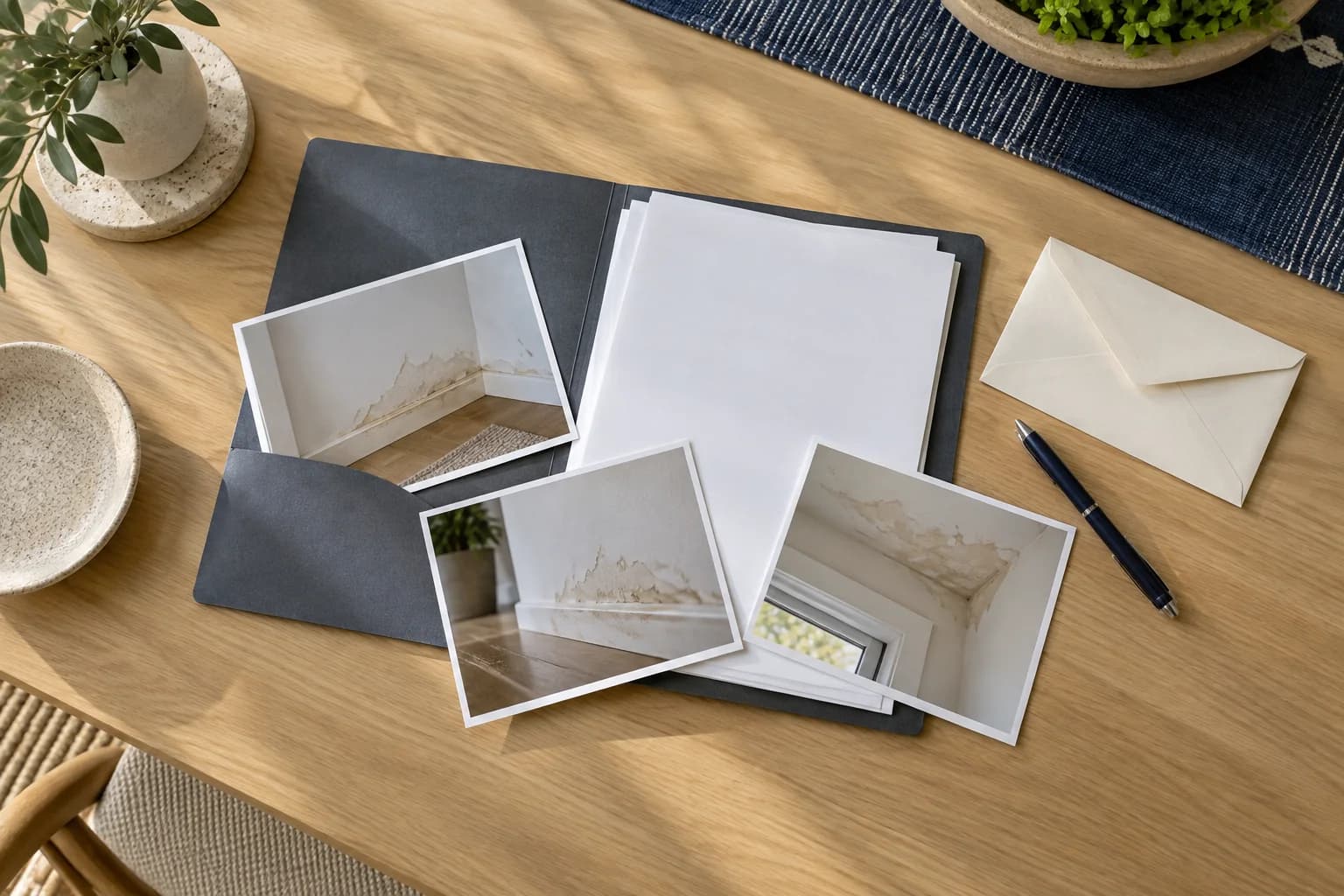
- Photograph what you can safely see. Contact your insurer and keep receipts and call notes.
Space to fill in
- Water shutoff location
- Plumber / emergency number
- Damage found: date / time
- Restoration visit / next step
Reference guidance
Make it your own
Keep the details together
Damage documentation organizer
Record what happened, follow room-by-room photo prompts and export notes and photos in one organized record.
Start your damage recordQuick Answer: Professional water damage restoration follows a 7-phase process: emergency contact and confirmed dispatch availability, inspection and moisture mapping with thermal imaging, industrial water extraction (removes 95%+ of water vs. 40-60% with consumer equipment), structural drying with commercial dehumidifiers (3-7 days), cleaning and antimicrobial treatment, daily moisture monitoring, and final restoration or reconstruction. The entire process takes 1-4 weeks depending on severity. Call Save The Day Restoration at (562) 246-9908 for IICRC-certified emergency response across LA and Orange County.
Why Does Professional Water Damage Restoration Follow a Specific Process?
Water damage restoration isn't simply about removing visible water and drying things out. It's a science-based process governed by IICRC S500 industry standards that addresses the full scope of damage—including moisture you can't see, contamination you can't smell, and structural compromise you can't feel. Cutting corners or skipping steps leads to mold growth, ongoing deterioration, and failed insurance claims.
At Save The Day Restoration, every project we handle across Los Angeles and Orange County follows these standards precisely. Our IICRC-certified technicians (Water Restoration Technician credential) are trained in the science of psychrometry—the study of how moisture moves through air and building materials—which is essential for ensuring complete and proper drying.
Understanding what happens during each phase helps you know what to expect, make informed decisions, and communicate effectively with both your restoration team and your insurance adjuster.
How Long Does the Complete Water Damage Restoration Process Take?
Every project is different, but here are typical timelines for Southern California homes:
Minor damage (single room, Category 1 clean water): Emergency response and extraction on day 1, drying over days 2-5, minor repairs during week 2. Total: 1-2 weeks.
Moderate damage (multiple rooms, Category 1 or 2 water): Emergency response and extraction on days 1-2, drying over days 2-7, cleaning and treatment during week 2, repairs and reconstruction during weeks 2-3. Total: 2-3 weeks.
Severe damage (extensive area, Category 2 or 3 water): Emergency response, extraction, and containment over days 1-3, drying over days 3-10, demolition of unsalvageable materials during week 2, antimicrobial treatment during weeks 2-3, reconstruction during weeks 3-6. Total: 3-6 weeks.
Several factors specific to Southern California can affect these timelines. Coastal humidity in areas like Long Beach, Huntington Beach, Newport Beach, and Redondo Beach can extend drying times by 1-3 days. Slab-on-grade construction common throughout LA and Orange County requires specialized drying techniques for concrete moisture. Older homes in Pasadena, Glendale, and Santa Ana may have materials that absorb and retain water differently than newer construction.
Phase 1: What Happens When You Call for Emergency Response?
When you call Save The Day Restoration's 24/7 emergency line at (562) 246-9908, the process begins immediately. Our dispatcher collects critical information: the source and cause of the water damage, which areas of your home are affected, whether water is still flowing, any safety concerns (electrical hazards, sewage, structural issues), and your insurance information for direct billing.
While you wait for our team (arrival timing is confirmed when you call), the dispatcher provides safety guidance: shut off the water source if possible, turn off electricity in affected areas if safe to do so, elevate furniture and valuables off wet surfaces, and avoid walking through standing water if the source is unknown (it could be contaminated).
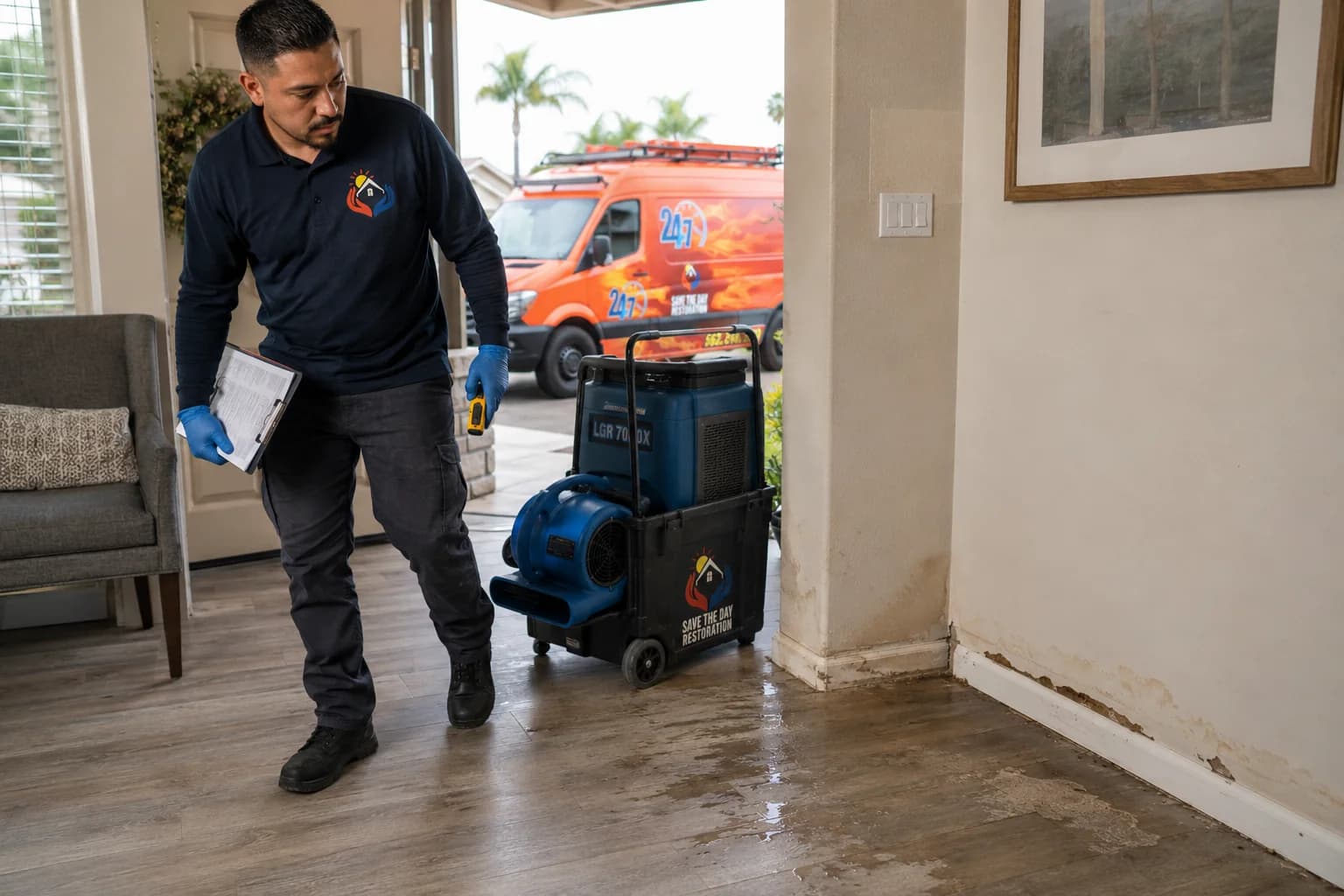
Our emergency response vehicles arrive fully equipped with truck-mounted water extraction units, portable extractors for tight spaces, submersible pumps for high-volume standing water, moisture meters and thermal imaging cameras, commercial dehumidifiers and air movers, HEPA air scrubbers, antimicrobial treatments, and full personal protective equipment for contaminated water scenarios.
Phase 2: How Do Technicians Inspect and Assess the Damage?
Before any equipment is set up, our IICRC-certified technicians conduct a thorough inspection that determines every subsequent decision in the restoration process. This assessment typically takes 30-60 minutes and includes three critical determinations:
How Is Water Classified?
Water is classified into three categories based on contamination level, and this classification dictates the entire restoration protocol:
Category 1 (Clean Water): Water from a sanitary source such as a broken supply line, faucet, or ice maker line. This water is safe to contact and the least expensive to remediate. However, Category 1 water that sits for more than 48 hours can degrade to Category 2 as bacteria multiply.
Category 2 (Gray Water): Water containing chemical, biological, or physical contaminants that could cause illness. Sources include washing machine overflow, dishwasher leaks, toilet overflow without fecal matter, and HVAC condensate overflow. Gray water requires antimicrobial treatment and more careful handling.
Category 3 (Black Water): Grossly contaminated water containing pathogens, toxins, or other harmful agents. Sources include sewer backups, toilet overflow with fecal matter, rising flood water, and any standing water that has been stagnant for extended periods. Category 3 water is a serious health hazard requiring full PPE, containment protocols, and disposal of all porous materials that contacted the water.
How Is Damage Classified?
Damage is classified into four classes based on how much water has been absorbed and the type of materials affected:
Class 1 (Least amount): Water affected only a small area with minimal absorption into materials. A portion of one room with water on hard surfaces.
Class 2 (Significant amount): Water has wicked up walls 12-24 inches, saturated carpet and padding, and affected the entire room. This is the most common class for residential water damage in LA and Orange County.
Class 3 (Greatest amount): Water has come from above (burst pipe in ceiling, roof leak) and saturated ceilings, walls, insulation, carpet, and subfloor. The entire room may be saturated from ceiling to floor.
Class 4 (Specialty drying): Water has penetrated deep into low-permeance materials like hardwood, plaster, concrete, or stone that require extended drying time and specialized equipment.
What Does Moisture Mapping Involve?
Using moisture meters and thermal imaging cameras, our technicians create a detailed moisture map of the entire affected area. This map documents the exact extent of moisture penetration—often revealing damage far beyond what's visible to the eye. Water regularly travels 10-20 feet from the original source through wall cavities, under flooring, and along plumbing runs. This moisture map becomes critical documentation for your insurance claim and the baseline against which drying progress is measured.
Phase 3: How Is Water Extracted?
Water extraction is the most time-critical phase. The faster water is removed, the less damage occurs and the shorter the drying phase will be. Professional extraction typically takes 4-8 hours depending on the volume of water and size of the affected area.
Our extraction equipment operates at industrial capacity: truck-mounted extractors that remove hundreds of gallons per hour (1,000x more powerful than consumer wet/dry vacuums), portable extractors for accessing closets, bathrooms, and tight spaces, submersible pumps for removing deep standing water (basements, severe flooding), and weighted extraction tools that press water out of carpet and padding.
The difference between professional and DIY extraction is dramatic. Consumer equipment typically removes only 40-60% of water from building materials, leaving enough residual moisture to fuel mold growth within 48-72 hours. Professional equipment extracts 95%+ of water, dramatically reducing drying time and mold risk.
For Category 2 and 3 water, extraction also includes removing all contaminated porous materials that cannot be properly cleaned and disinfected. Carpet padding is almost always removed and discarded after Category 2 or 3 exposure. Drywall that has absorbed contaminated water is cut out to at least 12 inches above the visible waterline. Insulation contacted by gray or black water is removed and replaced.
Phase 4: How Does the Professional Drying Process Work?
Structural drying is the most critical phase of water damage restoration—and the one that separates professional restoration from DIY attempts. Proper drying requires the right equipment, the right placement, and daily monitoring to prevent mold growth while avoiding over-drying that can cause its own damage.
What Equipment Is Used for Structural Drying?
Commercial dehumidifiers: Our LGR (Low Grain Refrigerant) dehumidifiers remove 10-20 gallons of moisture from the air per day. For a typical 3-bedroom home in LA or Orange County, we deploy 2-4 dehumidifiers depending on the extent of damage. These units operate continuously, pulling moisture out of the air so that wet building materials can release their absorbed water.
High-velocity air movers: These units are 20-40x more powerful than consumer box fans and are strategically positioned to create airflow patterns that maximize evaporation from wet surfaces. Proper placement is critical—air movers are angled to create a vortex effect that draws moisture from deep within building materials to the surface where it can evaporate.
Injectidry systems: For water trapped inside wall cavities, these specialty drying systems deliver heated, dry air directly into the wall through small panels—drying from the inside out without requiring demolition. This technology can save thousands of dollars by preserving walls that would otherwise need to be torn out.
Hardwood floor drying mats: When hardwood floors are exposed to water, specialty drying mats create a sealed vacuum system that pulls moisture upward through the wood, often saving floors that would otherwise need complete replacement (a $15,000-$40,000 cost in many LA and Orange County homes).
How Long Does Drying Take?
Typical drying times by material: carpet and padding take 2-3 days, drywall takes 3-5 days, hardwood flooring takes 5-10 days, concrete slab takes 7-14 days, and plaster walls (common in older LA homes) take 7-14 days.
In coastal Southern California communities, higher ambient humidity can extend these timelines by 1-3 days. Our technicians adjust equipment capacity and placement based on each property's specific conditions.
Phase 5: What Cleaning and Sanitizing Is Performed?
Once drying is underway, cleaning and antimicrobial treatment begins. The scope depends on the water category:
Category 1: Surfaces are cleaned with appropriate cleaning agents. Contents are wiped down, dried, and restored. Air scrubbers run continuously to remove airborne particles and odors.
Category 2: All contacted surfaces are treated with EPA-registered antimicrobial solutions. HEPA air scrubbers filter airborne contaminants. Affected clothing and soft goods are professionally laundered or dry-cleaned. Electronics are assessed for contamination before any attempt to power them on.
Category 3: Full containment barriers are erected to prevent cross-contamination. All porous materials contacted by black water are removed and disposed of (carpet, padding, drywall, insulation, particleboard). All remaining surfaces are treated with hospital-grade antimicrobial agents. HEPA air scrubbers and negative air machines run continuously. Personal protective equipment (PPE) is required for all workers in the affected area. Post-treatment verification confirms effective decontamination.
Phase 6: Why Is Daily Moisture Monitoring Essential?
Throughout the drying process, our technicians visit the property daily (or twice daily for severe projects) to take moisture readings at dozens of points throughout the affected area. These readings are compared against the initial moisture map to track drying progress and are documented in a detailed drying log.
Daily monitoring serves several critical purposes. It confirms that drying is progressing on schedule. It identifies areas where additional equipment or repositioning is needed. It prevents over-drying, which can crack wood, shrink materials, and cause secondary damage. It provides documented proof for your insurance company that the drying process met IICRC standards. And it determines exactly when materials have reached their dry standard—typically defined as equilibrium moisture content (EMC) for the specific material and local climate conditions.
Equipment is removed only when moisture readings confirm that all materials have returned to acceptable levels. Premature equipment removal is one of the most common causes of mold growth after supposedly "completed" water damage restoration.
Phase 7: What Does Final Restoration and Reconstruction Include?
Once drying is verified complete, the rebuilding phase restores your home to its pre-damage condition. As a licensed California general contractor (#1049188), Save The Day Restoration handles the complete reconstruction process—one company, one project manager, seamless from emergency response to final walkthrough.
Minor restoration typically includes: replacing carpet and padding, reinstalling or replacing baseboards and trim, patching and repainting affected drywall, replacing damaged cabinet components, and reinstalling flooring transitions and thresholds.
Major restoration may include: complete drywall replacement in affected rooms, subfloor repair or replacement, hardwood floor sanding and refinishing (or complete replacement), cabinet and countertop replacement, bathroom tile and fixture replacement, electrical and plumbing repairs, structural framing repairs, and complete room rebuilds matching original finishes and materials.
How Much Does Professional Water Damage Restoration Cost in LA and Orange County?
Costs vary based on water category, damage classification, affected area size, and materials involved:
Category 1 (Clean Water): $1,500-$4,000 for typical single-room damage. Includes extraction, drying equipment, monitoring, and basic repairs.
Category 2 (Gray Water): $3,500-$7,500 for typical residential damage. Adds antimicrobial treatment, possible material removal, and more extensive cleaning.
Category 3 (Black Water): $7,000-$15,000+ for comprehensive remediation. Includes containment, material disposal, intensive decontamination, and more extensive reconstruction.
Reconstruction costs range from $1,000-$100,000+ depending on scope—from simple drywall patches to complete room rebuilds.
Most homeowner insurance policies cover sudden and accidental water damage. Save The Day Restoration provides direct insurance billing, detailed documentation, and works directly with adjusters to ensure your claim is processed smoothly. Your out-of-pocket cost is typically limited to your deductible.
FAQ: Water Damage Restoration Process
Q: Can I stay in my home during water damage restoration?
A: For minor Category 1 damage, usually yes—though equipment noise can be disruptive. For extensive damage, Category 2 or 3 water, or any visible mold, temporary relocation is recommended. Insurance typically covers temporary housing under Additional Living Expenses (ALE) coverage.
Q: Will insurance cover professional water damage restoration?
A: Most homeowner policies cover sudden, accidental water damage from burst pipes, appliance failures, and similar events. Flood damage requires separate NFIP coverage. Save The Day Restoration provides complete documentation and direct insurance billing to streamline your claim.
Q: How do I know when drying is actually complete?
A: Professional moisture meters confirm that all building materials have returned to acceptable moisture levels—typically 12-15% or lower, depending on the material. Your restoration company should provide documented moisture readings proving drying met IICRC standards before equipment is removed.
Q: Can I turn off the drying equipment at night to reduce noise?
A: No. Continuous operation is critical for proper drying. Interrupting the drying process extends the timeline, increases mold risk, and can compromise the effectiveness of the entire restoration. Equipment must run 24/7 until moisture readings confirm drying is complete.
Q: Why can't I just use fans and open windows to dry water damage?
A: Consumer fans move air across surfaces but lack the power to draw moisture from deep within building materials. Opening windows introduces uncontrolled humidity that can slow drying—especially in coastal Southern California. Professional equipment removes 95%+ of moisture vs. 40-60% with household methods, and controlled dehumidification prevents mold growth.
Q: What happens if water damage isn't professionally restored?
A: Incomplete drying leads to mold growth within 48-72 hours, ongoing structural deterioration, wood rot, persistent odors, and potential health hazards. Insurance may also deny future claims related to damage that wasn't properly remediated initially.
Q: How do I choose a reputable water damage restoration company?
A: Look for IICRC certification (specifically WRT—Water Restoration Technician), a valid California contractor's license, direct insurance billing capability, 24/7 emergency response, truck-mounted extraction equipment, and documented moisture monitoring protocols. Save The Day Restoration meets all these criteria.
Start Your Restoration Now
Every hour of delay after water damage increases the scope and cost of restoration. Professional intervention within the first 2-4 hours gives you the best chance of minimizing damage, preventing mold, and restoring your home quickly and completely.
Call Save The Day Restoration at (562) 246-9908 for immediate 24/7 emergency response throughout Los Angeles and Orange County. Our teams confirm availability and the equipment needed for the property and handle every phase of restoration from emergency extraction through final reconstruction. We serve all of LA and Orange County, provide documentation for insurer review and discuss any available billing arrangements, and stand behind our work as licensed general contractor #1049188.
How we prepare and update our guides
Related serviceWater Damage RestorationEmergency water extraction & dryingAbout Save The Day Restoration
Save The Day Restoration is a locally owned, IICRC-certified restoration and reconstruction company serving all of Los Angeles and Orange County. The team coordinates water, fire, and mold restoration and reconstruction, including specialist work when needed. Licensed (CSLB #1049188), bonded, and insured, with 24/7 emergency response.
Call (562) 246-9908