In this guide
Restaurant fire recovery requires coordination with the relevant fire, building, and health authorities. Address damaged systems, food and surfaces, repairs, and any required inspections before reopening.
Keep it handy
A free printable for this guide
Save a copy for your fridge or binder. No email needed.
Property & business recovery log
Coordinate site contacts, affected areas, records and reopening questions.
Read the checklist online
For property managers, offices, schools, restaurants and facilities. Use with your existing emergency and continuity plans.
Protect occupants first. Reopening may require building, fire, health or other authority approval; a completed checklist is not clearance.
Assign the next steps
- Account for occupants and establish a safe contact point outside restricted areas.
- Identify the site lead, property owner, insurer and restoration contact.
- Record affected rooms, inventory, equipment and records without entering unsafe areas.
- Assign who will notify staff, tenants, families, customers or vendors as relevant.
- Ask the appropriate authorities what inspections or approvals are needed before reopening.
Space to fill in
- Site / incident date
- Site lead / emergency contact
- Owner / insurer / restoration contact
Recovery actions
Columns: Area / priority; Action / owner; Due / status. 4 blank rows.
Reference guidance
Restaurant Fire Recovery: Health Code Compliance After Restoration
Restaurant fire recovery extends far beyond structural restoration and equipment replacement. Health department re-inspection, grease trap and hood system decontamination, HVAC decontamination, and regulatory compliance determine whether a restaurant can legally reopen—often adding weeks to recovery timelines and tens of thousands to restoration costs. Understanding these requirements before fire strikes allows restaurant owners to prioritize critical compliance work and accelerate return-to-operations.
Why Restaurant Fire Recovery Is Different from Standard Fire Restoration
Standard fire restoration focuses on fire damage cleanup, structure repair, and equipment replacement. Restaurant fire recovery adds complex regulatory requirements unique to food service operations. The Los Angeles County Department of Public Health and Orange County Health Care Agency impose strict requirements before restaurants can legally resume service.
These requirements include: complete health department re-inspection with fire damage remediation verified, grease trap system decontamination and certification, hood and ductwork decontamination, HVAC system decontamination, food safety certifications, equipment inspections, and water system safety certification. Each of these components involves specialized contractors, regulatory documentation, and health department approval.
A restaurant with completed structural restoration and functioning equipment may still be legally prohibited from opening if health department requirements aren't satisfied. Many restaurant owners face timeline delays of 4-8 weeks beyond structural completion while waiting for health department re-inspection and specialized decontamination work.
Health Department Re-Inspection Requirements in LA and Orange County
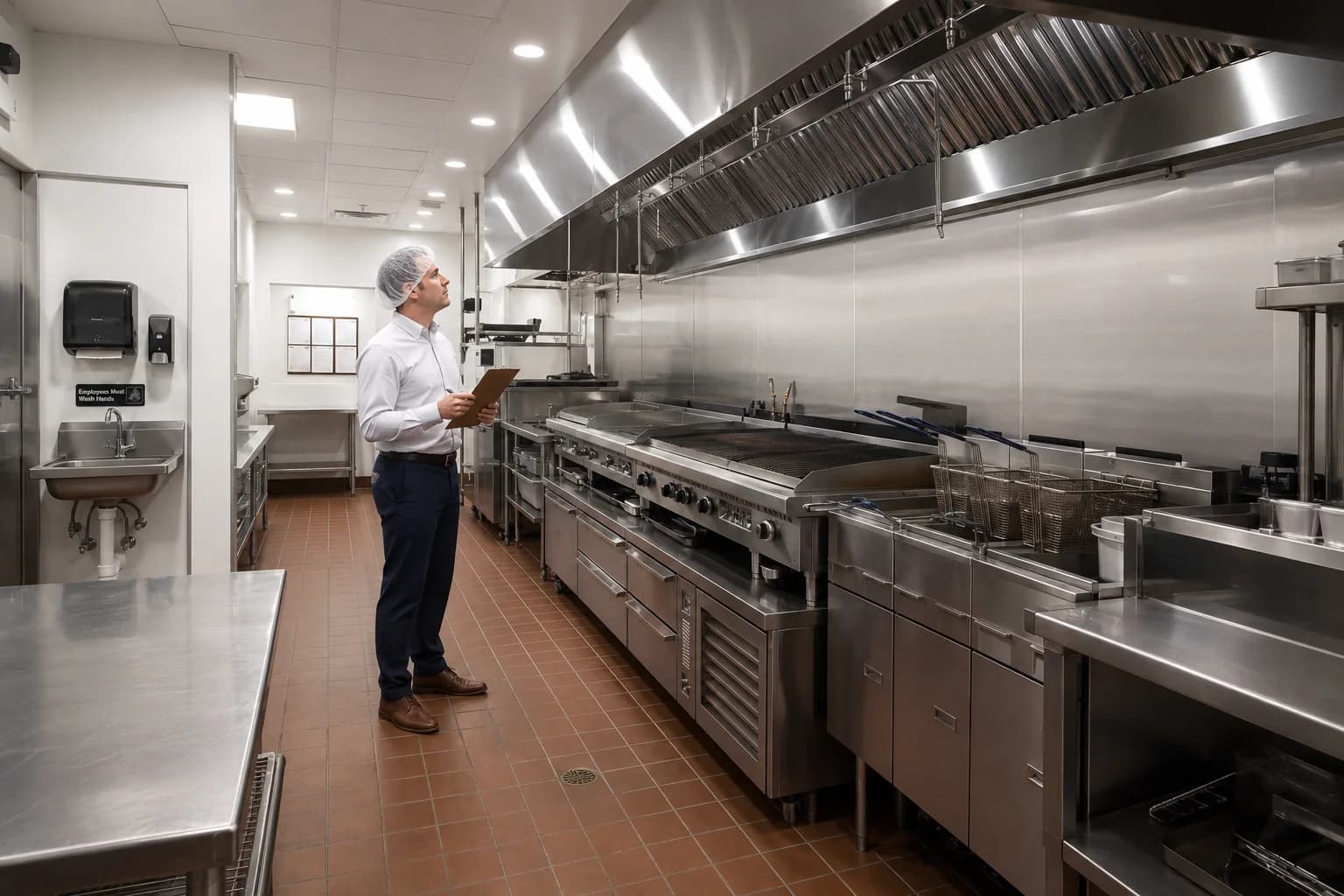
The Los Angeles County Department of Public Health and Orange County Health Care Agency require complete facility re-inspections before fire-damaged restaurants can reopen. These inspections address: structural integrity and fire code compliance, plumbing and water safety, electrical systems and equipment functionality, HVAC system operation and decontamination, grease trap system integrity and decontamination, food storage and preparation areas, pest control and sanitation.
Health inspectors specifically examine contamination from smoke and fire suppression water. Even buildings that appear structurally sound may have contaminants in plumbing systems, HVAC ductwork, and grease traps. Restaurants cannot reopen until inspectors verify that fire suppression contamination has been fully removed.
The inspection timeline varies significantly. If compliance issues are minimal, re-inspection might occur 5-7 days after restoration completion. If major systems require additional work, re-inspection might be delayed 2-3 weeks while contractors complete repairs and obtain necessary permits.
Pro tip: Contact the health department early in restoration planning. Ask what specific items will be re-inspected, what documentation they'll require, and whether pre-inspection consultations are available. Some health departments allow informal consultations that clarify requirements before formal re-inspection occurs.
Grease Trap and Plumbing System Decontamination
Restaurant grease traps accumulate oils, fats, and solids that create ideal environments for bacterial growth. Fire suppression chemicals and water can contaminate grease traps, making them unusable without professional decontamination and certification.
Specialized grease trap service companies pump, clean, and inspect the entire grease trap system. They verify that fire suppression water and chemicals haven't compromised the tank integrity, confirm proper operation of baffles and outlet systems, and provide certification documentation for the health department.
Beyond grease traps, the entire plumbing system must be verified safe. Fire suppression water can introduce contaminants into water supply lines. Restoration professionals work with licensed plumbers to flush the entire water system, verify water safety through testing if required, and ensure all fixtures operate safely.
Cost for comprehensive grease trap service ranges $800-$2,000 depending on tank size and contamination level. Plumbing system flushing and verification typically costs $1,500-$5,000 for restaurant-sized systems. These costs are often covered by property insurance business interruption coverage or included in restoration cost estimates.
Hood and Ductwork Decontamination: Critical HVAC Work
Restaurant cooking hoods accumulate grease residue that poses serious contamination and fire hazard. When fires occur, grease trap grease combined with smoke and fire suppression chemicals contaminates the entire hood and ductwork system. This contamination creates health hazards and violates health codes.
Professional hood cleaning requires specialized contractors who understand California health code requirements. The work involves: complete hood removal or in-place cleaning depending on damage level, pressure washing and chemical degreasing of hood exterior and interior surfaces, complete ductwork cleaning and degreasing from hood to roof penetration, damper and louver cleaning, and professional certification of system cleanliness.
Ductwork cleaning is particularly critical and often overlooked. Fire suppression water and smoke travel through ductwork even if the hood itself is protected. Contaminated ductwork must be professionally cleaned and inspected. Some situations require ductwork replacement if cleaning cannot achieve health code standards.
Hood and ductwork decontamination costs range $3,000-$10,000+ depending on hood size, ductwork complexity, and contamination severity. This is a specialized service that must be completed before health department re-inspection, making it a critical path item in post-fire restoration timelines.
HVAC System Decontamination and Recommissioning
Beyond hood and cooking ductwork, the entire HVAC system requires decontamination after fire damage. Restaurant HVAC systems distribute air throughout facilities, and smoke contamination can spread through the entire system.
HVAC decontamination involves: complete system shut-down and isolation, ductwork cleaning and decontamination, filter replacement, equipment inspection and cleaning, system pressure testing to verify integrity, and professional commissioning to confirm proper operation.
California Title 24 energy code requirements add complexity. Many commercial HVAC systems require certification and documentation of proper recommissioning after major system work. Contractors must provide signed commissioning reports verifying that systems operate according to design specifications.
If HVAC systems are severely damaged, replacement may be necessary. Restaurant HVAC systems are often specialized to meet health code requirements for fresh air intake, exhaust capacity, and humidity control. System replacement can cost $15,000-$50,000+ for mid-sized restaurants.
HVAC decontamination and recommissioning typically costs $3,000-$15,000 and can require 2-3 weeks depending on system complexity. Because this is on the critical path for health department re-inspection, scheduling HVAC work early in restoration is essential.
Food Safety Certifications and Equipment Inspections
Before reopening, restaurants must verify that food preparation equipment meets health code requirements. This includes: refrigeration equipment (reaches proper temperatures), cooking equipment (functions safely), food storage areas (temperature controlled, pest-proof), and food handling surfaces (properly installed and cleanable).
Any equipment that contacted fire suppression water may require replacement or professional recertification. Some manufacturers allow equipment cleaning and recertification; others require replacement. Determine this early for critical equipment so replacement can be ordered and delivered during restoration.
Many restaurants also choose to update equipment during fire recovery, taking advantage of insurance settlement to upgrade aging equipment. This can accelerate reopening timelines by replacing equipment needing replacement anyway.
Manager and staff food safety certifications must be current for reopening. Verify that food safety certified managers maintain current certifications. If certifications lapsed during closure, managers must recertify before the restaurant can legally operate.
Water System Safety and Certification
Fire suppression systems introduce large volumes of water into buildings. This water can contain particulates, chemicals, and biological contaminants that compromise the restaurant's water system.
Before reopening, the entire water system must be professionally flushed and, if required, tested for safety. Licensed plumbers verify that water pressure, water quality, and water temperature at all outlets meet health code requirements. Hot water systems must reach proper temperatures for sanitization.
If water testing reveals contamination, additional treatment or system replacement may be necessary. Most restaurants need basic flushing and verification ($1,500-$3,000), but some situations require more extensive work.
Business Interruption Insurance Coverage
Restaurant fire recovery is one of the most expensive disaster scenarios, both in direct restoration costs and business interruption losses. A mid-sized restaurant could face $50,000-$200,000+ in total costs (structural restoration plus lost revenue during closure) if recovery takes 4-8 weeks.
Most restaurants carry business interruption (business income) insurance, but coverage details vary significantly. Standard business interruption policies typically cover: lost profit during closure, ongoing expenses like payroll and utilities that continue despite closure, and extra expenses incurred to maintain operations (temporary location costs, increased delivery costs for supplies).
Coverage limits, deductible periods, and coverage exclusions vary dramatically. Some policies cover 30 days of closure; others cover 12 months. Some include coverage for forced closure by health department; others exclude it. Review your specific policy language immediately after a fire.
Work closely with your insurance adjuster to document the timeline from fire to reopening. The longer the health department re-inspection and compliance work takes, the greater the business interruption claim. Providing detailed documentation of compliance work—health department letters, contractor certifications, re-inspection reports—helps justify extended closure periods and increases claim approval.
Coordinating Restoration and Health Department Compliance
Optimal fire recovery requires careful coordination between restoration contractors, health department requirements, equipment vendors, and insurance adjusters. A typical post-fire restaurant recovery timeline looks like this:
Days 0-2: Emergency mitigation—firefighting water removal, stabilization of structure, safety assessment.
Days 2-7: Detailed damage assessment, insurance claim filing, equipment assessment (replace vs. recertify), restoration scope development, scheduling HVAC and hood cleaning, grease trap service scheduling.
Days 7-21: Structural restoration, equipment replacement/recertification, HVAC and hood system decontamination, plumbing system flushing, grease trap service.
Days 21-28: Final structural completion, all systems operational, health department pre-inspection consultation if available.
Days 28-35: Health department formal re-inspection, address any compliance gaps identified during inspection.
Days 35-42: Final compliance verification, health permit reissuance, staff retraining and certifications current, opening preparation.
This 6-week timeline represents best-case scenarios with minimal complications. Complex fires with extensive contamination, equipment damage, or structural issues easily extend timelines 8-12 weeks.
Choosing a Restoration Vendor for Restaurant Fire Recovery
Restaurant fire recovery requires specialized expertise beyond standard fire restoration. Your vendor should understand: restaurant-specific systems (cooking hoods, grease traps, commercial-grade HVAC), health code requirements and re-inspection processes, coordination with specialized contractors (hood cleaners, grease trap services, HVAC specialists), insurance claim coordination including business interruption documentation, and timeline management that prioritizes critical path compliance work.
Ask prospective vendors specifically about restaurant fire recovery experience. Have they handled fires at food service establishments? Do they understand health department re-inspection requirements? Can they coordinate with hood cleaning and grease trap service companies? Do they have relationships with health department personnel or consultants who can clarify compliance requirements?
References from other restaurant owners who experienced fires are invaluable. Ask about timeline, costs, health department re-inspection success, and whether the vendor helped accelerate compliance and reopening.
Cost Ranges: Fire Damage Restoration Plus Health Compliance
Structural restoration costs for restaurant fires vary dramatically based on size, damage extent, and equipment damage. A small 1,500 sq ft restaurant with moderate fire damage might cost $30,000-$50,000 for structural restoration. A larger 5,000+ sq ft facility with extensive damage could reach $100,000+.
Add health compliance costs: grease trap service ($800-$2,000), hood and ductwork decontamination ($3,000-$10,000), HVAC decontamination ($3,000-$15,000), plumbing system flushing ($1,500-$5,000), equipment replacement or recertification ($5,000-$30,000+). Total health compliance costs range $13,300-$62,000+.
Business interruption losses dwarf all other costs. A closure timeline of 6-8 weeks means $50,000-$200,000+ in lost revenue for most restaurants. If business interruption insurance carries lower limits or longer deductible periods, owners can face devastating uninsured losses.
Frequently Asked Questions
Q: How long does health department inspection and approval take after fire damage?
A: Health department inspections typically occur 5-10 days after fire damage, depending on your county's backlog. LA and Orange County inspectors verify kitchen ventilation, grease trap compliance, sanitization protocols, and food handling areas. Save The Day Restoration can prioritize these compliance areas to accelerate the inspection timeline and help your restaurant reopen sooner.
Q: What grease trap compliance is required before reopening?
A: Grease traps must be professionally cleaned and inspected after fire damage. The health department verifies trap integrity, functionality, and documentation. Your contractor must provide proof of cleaning and compliance certification. Save The Day Restoration coordinates with licensed grease trap cleaning services in Signal Hill and surrounding areas to ensure full compliance before reopening.
Q: Does business interruption insurance cover our losses while we're closed?
A: Yes, business interruption insurance typically covers lost profits, payroll, and fixed costs during involuntary closure due to fire. Coverage usually begins after a waiting period (typically 72 hours) and continues until the business reopens. Save The Day Restoration provides detailed documentation of the closure period and restoration timeline to support your insurance claim.
Q: What health code items must be replaced versus restored?
A: Single-use items (food packaging, utensils, linens) and items exposed to fire/smoke (open food, spices, oils) must be discarded. Equipment like refrigerators, stoves, and ventilation systems can be restored if cleaned and inspected by certified professionals. Save The Day Restoration works with health department requirements to determine what must be replaced for code compliance.
Q: How do we document everything for health inspection approval and insurance?
A: Document all damage with photos and videos before beginning restoration. Keep detailed records of cleaning, equipment replacement, and compliance certifications. Save The Day Restoration (562) 246-9908, IICRC Certified and licensed #1049188, provides comprehensive damage reports and restoration documentation required by both health inspectors and insurance carriers in LA and Orange County.
Restaurant fire recovery is complex, expensive, and heavily regulated. The difference between reopening in 6 weeks versus 12 weeks often depends on understanding health department requirements and coordinating compliance work with structural restoration. Don't wait until fire strikes to understand these requirements—contact your health department today and ask about fire recovery compliance procedures and timelines. For expert fire restoration and health code compliance coordination, call Save The Day Restoration & Reconstruction at (562) 246-9908. Our IICRC-certified team (License #1049188) specializes in restaurant fire recovery, understands LA County and Orange County health department requirements, and coordinates with specialized contractors for hood cleaning, grease trap service, and HVAC decontamination. We've helped numerous restaurants reopen quickly and safely after fire damage. Schedule a pre-loss consultation today to discuss your restaurant's restoration readiness.
How we prepare and update our guides
Related serviceCommercial ServicesOffice, retail & industrial restorationAbout Save The Day Restoration
Save The Day Restoration is a locally owned, IICRC-certified restoration and reconstruction company serving all of Los Angeles and Orange County. The team coordinates water, fire, and mold restoration and reconstruction, including specialist work when needed. Licensed (CSLB #1049188), bonded, and insured, with 24/7 emergency response.
Call (562) 246-9908