
In this guide
Notify your insurer promptly, record damage when safe and compare the proposed repair scope with your records. Ask about policy requirements, deadlines, deductibles and uncovered costs before authorizing work.
Keep it handy
A free printable for this guide
Save a copy for your fridge or binder. No email needed.
Insurance conversation planner
Gather questions, claim contacts and next steps before you speak with your insurer.
Read the checklist online
Use this to prepare for a call about coverage, an estimate, a denial or a claim update.
Ask your insurer to explain your own policy and any deadlines in writing. This is an organizer, not legal advice or a promise of coverage.
Questions to ask
- What policy wording applies to this loss, and what documents do you still need?
- What are the next steps, contact person and applicable submission dates?
- How should I document urgent work, damaged items and temporary living expenses?
- If an amount or decision is disputed, can you explain it in writing and describe the review process?
Space to fill in
- Insurer / claim reference
- Contact / phone or email
- Call date / person spoken to
- Questions / documents still needed
- Written explanation / policy section
- Next action / owner / due date
Reference guidance
Make it your own
Keep the details together
Damage documentation organizer
Record what happened, follow room-by-room photo prompts and export notes and photos in one organized record.
Start your damage recordQuick answer: Put safety first, notify your insurer promptly, document the damage when safe, and ask about the policy's reporting and proof-of-loss requirements. Review the insurer's scope and estimate against the observed damage before agreeing to a settlement. Coverage and payment depend on your policy and the facts of the loss. See CDI's property claims guide.
Why Is Understanding the Insurance Claims Process So Important?
Filing a property damage insurance claim is something most homeowners do once or twice in their lifetime—but insurance companies process thousands of claims every day. This knowledge imbalance puts homeowners at a significant disadvantage during one of the most stressful experiences they'll face. Understanding how the process works, what your rights are under California law, and where common pitfalls lie can make a difference of thousands or even tens of thousands of dollars in your final settlement.
At Save The Day Restoration, we've guided hundreds of Los Angeles and Orange County homeowners through the property damage claims process for water damage, fire damage, mold, and storm damage. We've seen firsthand how well-documented claims with proper support receive full coverage, while poorly managed claims result in underpayment, delays, and denials. This guide walks you through every stage of the process so you know exactly what to expect and how to protect your interests.
What Should You Do Immediately After Discovering Property Damage?
How Quickly Must You Report the Damage?
Most California homeowner policies require you to report property damage "promptly" or within a specific timeframe—typically 24-48 hours. Call your insurance company's 24/7 claims line as soon as possible after discovering the damage. Early reporting demonstrates good faith and starts the clock on California's consumer protection timelines that require your insurer to act within specific deadlines.
When you call, have this information ready: your policy number, the date and time the damage occurred or was discovered, a brief description of what happened and what's damaged, whether emergency mitigation has been performed (board-up, water extraction), your current contact information, and the fire department or police report number if applicable.
The claims representative will assign you a claim number—write this down and reference it in every subsequent communication. They'll also assign an adjuster and provide an estimated timeline for the adjuster's inspection.
Why Is Pre-Cleanup Documentation Critical?
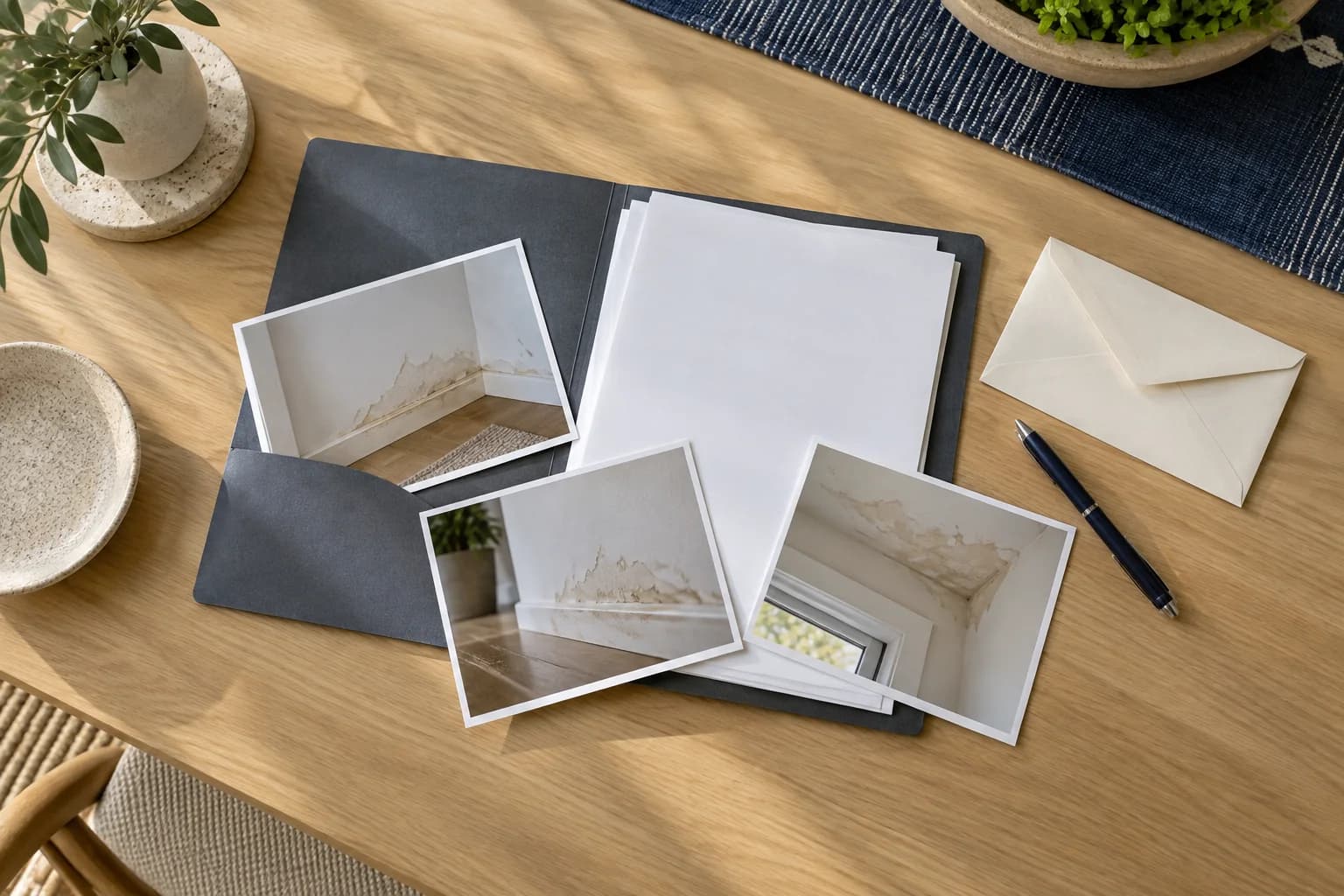
Documentation is the foundation of a successful insurance claim. Once cleanup begins, physical evidence is altered or destroyed—and you cannot recreate it. Before any cleanup or mitigation work starts, take 200-500 photographs covering every affected room from multiple angles, close-ups of specific damage, the source of the damage, every damaged personal item (with brand labels, model numbers, serial numbers visible), inside closets, cabinets, and drawers, HVAC vents and systems, and the exterior of the home if relevant.
Record video walkthroughs narrating what you observe—video captures scope and context that photos alone cannot. Include the date and time in your narration.
Create a written damage inventory listing every affected item with its description, approximate purchase date, estimated purchase price, and pre-damage condition. This inventory becomes the basis for your personal property claim.
What Are California's Insurance Claim Deadlines and Requirements?
California's Insurance Code provides specific consumer protections that your insurer must follow:
Initial acknowledgement: Ask when your report will be acknowledged and which documents are needed. California has claims-handling rules, but the starting event and applicable exceptions matter.
Coverage review: Ask the insurer to identify missing information and provide the basis for any extension in writing. Keep a record of submissions and follow-up communications.
Payment: Confirm what has been accepted, any required settlement documents and when payment is due. Different payments and policy benefits may follow different requirements.
Fair Claims Settlement Practices: California Insurance Code Section 790.03 prohibits unfair claims practices including misrepresenting policy provisions, failing to acknowledge communications promptly, failing to adopt reasonable investigation standards, not attempting in good faith to effectuate prompt settlements, and compelling policyholders to initiate litigation to recover amounts due.
If your insurer violates these requirements, you can file a complaint with the California Department of Insurance (CDI) at 1-800-927-4357 or insurance.ca.gov.
What Happens During the Adjuster's Inspection?
The insurance adjuster's inspection is one of the most important moments in your claim. The adjuster—who works for the insurance company—will visit your property to inspect and photograph all damage, take measurements of affected areas, interview you about how the damage occurred, review the fire department or plumber's report, assess whether the damage is covered under your policy, and create a preliminary damage estimate.
How Should You Prepare for the Adjuster's Visit?
Walk through the property before the adjuster arrives and note every area of damage, even minor issues that might be overlooked. Prepare a list of questions about your coverage, timeline, and process. Have your photo and video documentation ready to share. If your restoration company has already begun emergency mitigation, have their documentation available (moisture readings, scope of work, photos).
What Should You Do During the Inspection?
Accompany the adjuster throughout the entire inspection. Point out all damage—adjusters are thorough but may miss hidden damage behind walls, in attics, or under flooring. Take your own notes on what the adjuster says and does. Ask the adjuster to explain anything you don't understand. Request the adjuster's direct contact information for follow-up questions.
If your restoration company can be present during the adjuster's visit, this is ideal. They can point out damage the adjuster might miss and provide technical context about restoration requirements.
How Do You Maximize Your Insurance Settlement?
Why Should You Get Independent Contractor Estimates?
The insurance company will produce their own repair estimate, but you should obtain 2-3 independent estimates from licensed, IICRC-certified restoration contractors. These independent estimates often identify costs the insurance estimate misses, including hidden damage that requires exploratory demolition to discover, California code upgrade requirements (Title 24 compliance), proper drying and monitoring protocols per IICRC standards, premium materials matching your home's original finishes, and permit fees and engineering costs.
Insurance estimates frequently use lower-cost materials, don't account for code upgrades, and may underestimate the scope of work. Independent estimates provide leverage during settlement negotiations.
Why Should You Never Accept the First Offer?
Review the proposed settlement rather than accepting or rejecting it automatically. Compare quantities, materials, repair methods, depreciation, deductibles and limits with the policy and contractor's scope. Ask for an explanation of specific differences and provide supporting records.
Review the initial offer carefully for missing items from your personal property inventory, undervalued items (check replacement costs online), incomplete scope of repair work, missing code upgrade costs, inadequate Additional Living Expenses (ALE), and low-quality replacement materials specified instead of matching originals.
Respond to every discrepancy in writing with supporting documentation. Professional restoration companies that use Xactimate pricing software can provide line-by-line comparisons showing where the insurance estimate falls short.
When Should You Consider Hiring a Public Adjuster?
A public adjuster is a licensed professional who works for you (not the insurance company) to negotiate your claim. Consider hiring one when the claim exceeds $50,000, the insurance company is significantly underpaying, your claim has been denied and you believe it should be covered, you don't have time to manage a complex claims process, or damage assessment is complicated with multiple types of damage.
Before hiring a public adjuster, verify the California license and review the written contract, fees, scope and cancellation terms. Ask how fees apply to amounts already offered or paid. No increase in payment is guaranteed.
What Types of Coverage Apply to Property Damage Claims?
Dwelling Coverage (Coverage A): Covers the structure of your home including walls, roof, foundation, built-in appliances, permanently installed fixtures, attached structures (garage, deck), and systems (electrical, plumbing, HVAC). Limits: Typically the replacement cost of your dwelling.
Personal Property Coverage (Coverage C): Covers belongings including furniture, electronics, clothing, kitchenware, and personal items. Limits: Usually 50-70% of dwelling coverage. Special sublimits apply to jewelry ($1,000-$2,500 typical), cash ($200-$500), art and collectibles ($2,500-$5,000), and firearms ($2,500).
Additional Living Expenses (Coverage D/ALE): Covers temporary housing costs if your home is uninhabitable, including hotel or rental home, meals above normal food costs, storage fees, laundry, pet boarding, and additional transportation costs. Limits: Typically 12-24 months or 20-30% of dwelling coverage.
Ordinance or Law Coverage: Covers the cost of bringing your home up to current building codes during repairs. This is critically important in California, where Title 24 code upgrades can add 15-30% to reconstruction costs. Not all policies include this—check yours.
How Do Supplemental Claims Work?
Additional damage may be found as work proceeds. Document what was found, distinguish it from the original scope and ask the insurer how to submit a supplemental estimate. Newly discovered damage is not automatically covered.
To file a supplemental claim: stop work in the area where new damage was discovered, document the newly discovered damage with photos and detailed descriptions, have your restoration contractor prepare a supplemental estimate, notify your adjuster immediately, request a supplemental inspection, and do not proceed with repairs until the additional damage is approved.
Supplemental claims are common and expected in property damage restoration. Insurance adjusters are accustomed to them—don't hesitate to file when hidden damage is found.
What Should You Do If Your Claim Is Denied?
A claim denial is not necessarily the final word. California law gives you several options:
Request a written explanation: Your insurer must provide a detailed, written explanation of why your claim was denied, citing specific policy language.
Review your policy carefully: Compare the denial reason against your actual policy language. Denials are sometimes based on incorrect interpretations of policy provisions.
File a formal appeal: Submit a written appeal with additional documentation supporting your claim. Include independent contractor assessments, expert opinions, and any evidence that contradicts the denial reason.
Contact the California Department of Insurance: File a complaint at insurance.ca.gov or call 1-800-927-4357. The CDI investigates complaints and can intervene on your behalf.
Consult an insurance attorney: For significant claims, an attorney specializing in insurance bad faith can evaluate whether the denial violates California's Fair Claims Settlement Practices Act.
FAQ: Property Damage Insurance Claims in California
Q: How long do I have to file a property damage claim in California?
A: Most policies require prompt notification (24-48 hours), though you typically have up to one year to file the formal claim. However, delaying weakens your documentation and may raise questions about the damage timeline. Report the damage the same day you discover it.
Q: Will filing a claim affect my premium or renewal?
A: Ask your insurer or licensed agent how a claim may affect your policy. The answer depends on the policy, underwriting and applicable protections, including any rules for a particular declared disaster. Do not assume that every disaster claim is exempt from rate or renewal effects.
Q: What is the difference between Actual Cash Value and Replacement Cost Value?
A: Actual Cash Value (ACV) pays the depreciated value of damaged items—what they were worth at the time of the loss. Replacement Cost Value (RCV) pays what it costs to replace items with new equivalents. RCV policies typically pay 30-50% more. Check your policy—most California homeowner policies are RCV, but some are ACV.
Q: Can my insurance company require me to use their preferred contractors?
A: No. California law gives you the absolute right to choose any licensed contractor. Your insurer may recommend contractors through a preferred vendor program, but they cannot require you to use them, reduce your settlement for choosing someone else, or steer you away from your chosen contractor.
Q: How long does the entire claims process take?
A: For straightforward claims: 4-8 weeks from report to settlement. For complex claims with significant damage, supplemental claims, and negotiations: 2-6 months. Major reconstruction projects may involve ongoing claim activity for 6-12 months.
Q: What records should I keep throughout the claims process?
A: Keep copies of all written communication with your insurer, every photo and video of damage, all contractor estimates and invoices, receipts for emergency expenses (hotel, meals, supplies), your complete personal property inventory, the adjuster's contact information and all notes from conversations, and a timeline log of every interaction.
Q: Does Save The Day Restoration help with insurance documentation?
A: We can provide photographs, moisture records, drying logs and a restoration estimate, and explain the repair scope to your adjuster. Your insurer decides coverage. Confirm direct billing in advance; deductibles, limits and uncovered work may leave costs for the property owner.
Get Expert Claims Support
Navigating a property damage insurance claim while dealing with the stress of damage to your home is overwhelming. You don't have to do it alone. Save The Day Restoration provides comprehensive claims support for homeowners throughout Los Angeles and Orange County—from initial documentation through final settlement.
Call (562) 246-9908 to discuss restoration and damage documentation in LA or Orange County. Confirm availability, work authorization, billing arrangements and payment responsibilities before work begins. Licensed general contractor #1049188.
How we prepare and update our guides
Related serviceAdditional ServicesBoard-up, cleaning & specialty workAbout Save The Day Restoration
Save The Day Restoration is a locally owned, IICRC-certified restoration and reconstruction company serving all of Los Angeles and Orange County. The team coordinates water, fire, and mold restoration and reconstruction, including specialist work when needed. Licensed (CSLB #1049188), bonded, and insured, with 24/7 emergency response.
Call (562) 246-9908